
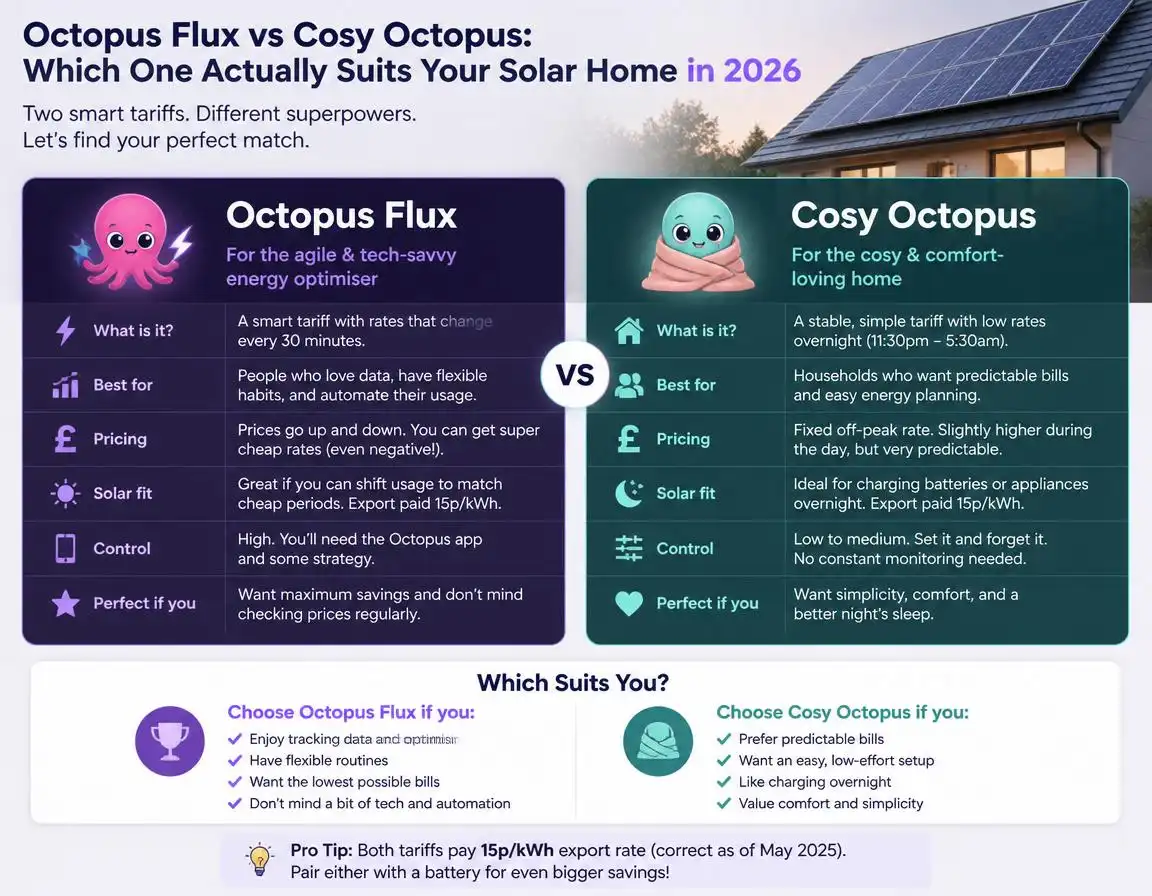
Octopus Flux vs Cosy Octopus: Which One Actually Suits Your Solar Home in 2026


I get asked some version of this question most weeks: “I’ve got solar panels — should I be on Octopus Flux or Cosy Octopus?” It’s a completely reasonable question, because the names sound like they might do a similar job. They don’t, really.
Octopus Flux is built for homes with solar panels and a battery. It pays you well for exporting stored or surplus power back to the grid at exactly the moment the grid needs it most.
Cosy Octopus is built for homes heating with electricity — a heat pump, electric boiler or electric radiators. It gives you cheaper electricity at set points in the day so your heating costs less to run. It has nothing to do with exporting solar power at all.
One tariff is about selling power. The other is about buying it more cheaply. Below, I’ve set out exactly how each one works, the current 2026 rates, who’s actually eligible, and a straight answer on which one — or which combination — fits your home. There’s also a fairly important 2026 update: one of these two tariffs currently isn’t taking new customers, and I’ll explain what that means for you.
The quick answer
| Your setup | Best fit |
|---|---|
| Solar panels only — no battery, no heat pump | Neither. A plain export tariff such as Outgoing Octopus (12p/kWh flat) is simpler and does the job. |
| Solar panels + a home battery | Octopus Flux — though see the 2026 availability note below before you get your hopes up. |
| Heat pump, electric boiler or electric radiators | Cosy Octopus — open to new customers, no exit fees. |
| Solar + battery + heat pump | Cosy for your heating, paired with a separate export tariff (e.g. Outgoing Octopus or Agile Outgoing) for your solar. |
Octopus Flux and Intelligent Octopus Flux have been paused to new customers since March 2026, with no confirmed reopening date. I go through what that means, and what to do instead, further down this guide. Cosy Octopus is unaffected and remains open as normal.
What is Octopus Flux, in plain English?
Octopus Flux is a combined import-and-export electricity tariff, and it’s only really relevant if you’ve already got solar panels and a home battery. Rather than one flat rate all day, your day is split into pricing windows — but the whole point of Flux is moving energy through your battery, not running a heat pump cheaply.
Here’s the daily shape of it, taken directly from Octopus’s own tariff page:
- 02:00–05:00 — the cheapest window. Good for topping your battery up from the grid if solar alone hasn’t filled it.
- 16:00–19:00 — the peak window, and the one that actually matters. This is when you’re paid the most for exporting stored or surplus solar power back to the grid.
- Everything else — a standard rate that sits between the two.
With standard Octopus Flux, you schedule your own battery — charging it overnight and discharging it at peak. With Intelligent Octopus Flux, Octopus takes that scheduling off your hands entirely and controls a compatible battery automatically, aiming to squeeze the most value out of every day.
| Detail | 2026 figure |
|---|---|
| Peak export rate — Octopus Flux | Up to 29.32p/kWh (16:00–19:00) |
| Peak export rate — Intelligent Octopus Flux | Up to 32.17p/kWh (16:00–19:00) |
| For comparison: Outgoing Octopus (flat, no battery needed) | 12p/kWh (cut from 15p on 1 March 2026) |
| For comparison: basic SEG-only rate | 4.1p/kWh |
| You’ll need | MCS-certified solar panels, a compatible home battery, an export MPAN, a smart meter with half-hourly reads, and an existing Octopus import + export tariff |
I’ve broken all five Octopus export tariffs down side by side, with the full current rate table, in my Octopus Energy solar export tariff guide — worth a look if Flux turns out not to suit your setup, since Outgoing Octopus and Agile Outgoing are both explained there too.
What is Cosy Octopus, in plain English?
Cosy Octopus is a completely different kind of tariff. It’s built for homes heating with electricity — air or ground source heat pumps, electric boilers, and electric radiators. It’s purely an import tariff: what you pay for electricity coming in. It doesn’t touch solar export at all, and you don’t need solar panels to join it.
Instead of a flat rate, Cosy gives you three “Cosy Hours” windows a day, plus a peak window:
- 04:00–07:00, 13:00–16:00 and 22:00–00:00 — three off-peak windows, roughly 51% cheaper than the standard day rate in your region. Eight hours of cheap electricity in total, every day.
- 16:00–19:00 — the peak window, roughly 50% higher than the standard day rate.
- Everything else — the standard day rate for your region.
So, as an illustration: if your region’s day rate happens to sit around 26p/kWh, Cosy Hours would land somewhere around 13p/kWh, and the peak window around 39p/kWh. Those are illustrative figures only, since Cosy’s rates are set per region and updated quarterly — always check your own postcode for the exact number.
Octopus’s own modelling puts the typical saving at around £82 a year on electricity for a heat pump household moving from its standard tariff to Cosy’s fixed product, based on annual consumption of 5,877kWh. That’s specifically Octopus’s electricity-only comparison for its own fixed tariff. The wider real-world saving from moving a heat pump onto a dedicated tariff like Cosy — rather than a standard variable rate — tends to run higher once you look at the full running-cost picture; I’ve modelled this closer to £200–£400 a year in my heat pumps in the UK guide, depending on how much heating and hot water you can shift into the cheap windows.
| Detail | 2026 figure |
|---|---|
| Off-peak (“Cosy Hours”) | ~51% below day rate · 3 windows · 8 hrs/day |
| Peak window | ~50% above day rate · 16:00–19:00 |
| Exit fees | None — no tie-in |
| Fuel covered | Electricity only (no gas version) |
| You’ll need | A heat pump, electric boiler, or electric radiators — solar is not required — plus a smart meter and an Octopus electricity account |
Flux vs Cosy: the head-to-head
Sell power at the right moment
- Import and export combined in one tariff
- Needs solar panels + a compatible battery
- You manage a battery schedule (or Octopus does, on the Intelligent version)
- Rewards you for exporting at 16:00–19:00
- Currently paused to new customers
Heat your home more cheaply
- Import only — no export element at all
- Needs a heat pump, electric boiler or electric radiators
- No battery or solar panels required
- Rewards you for using electricity in three daily windows
- Open to new customers, no exit fees

| Feature | Octopus Flux | Cosy Octopus |
|---|---|---|
| Energy direction | Import + export | Import only |
| Needs solar panels? | Yes | No |
| Needs a battery? | Yes | No |
| Needs a heat pump / electric heating? | No | Yes |
| Cheapest window | 02:00–05:00 | 04:00–07:00, 13:00–16:00, 22:00–00:00 |
| Priciest window | 16:00–19:00 (export pays most) | 16:00–19:00 (import costs most) |
| Exit fees | None | None |
| Open to new customers (2026)? | Paused since March 2026 | Yes |
What the numbers actually look like

The chart above is worth sitting with for a second, because it’s easy to glance at “up to 29.32p” for Flux and “~39p” for Cosy’s peak and assume Cosy is the pricier tariff overall. It isn’t quite that simple. Flux’s headline figure is money coming in — what you’re paid to export. Cosy’s headline figure is money going out — what you pay to import. They’re measuring opposite directions of energy flow, which is really the single most important thing to keep in mind when people bundle these two tariffs together in comparison articles.
Worked examples: what could you actually earn or save?
Scenario A — solar + battery, on an Octopus export tariff
Using the figures from my Octopus export tariff guide: a typical 4kWp system exporting 1,200kWh a year earns around £144 on flat-rate Outgoing Octopus at 12p/kWh, versus just £49 on the basic 4.1p SEG-only rate. If every one of those units could instead be exported at Flux’s 29.32p peak rate, that’s worth roughly £352 on paper. In practice you won’t hit that ceiling on every unit — you’re only exporting at the best rate for the kWh your battery can actually hold and discharge inside the 16:00–19:00 window, so your real blended rate across the year will usually land somewhere between the 12p flat rate and the 29.32p peak figure, not right at the top of it.
Scenario B — heat pump home, on Cosy Octopus
Octopus’s own figures suggest around £82 a year in electricity savings for a typical heat pump household switching to Cosy Fixed, and my own running-cost modelling in the heat pumps guide puts the wider saving (heat pump on a dedicated tariff vs a standard variable rate) closer to £200–£400 a year, depending how much of your heating and hot water you can shift into the three Cosy Hours windows.
| Scenario | Illustrative annual figure | Source basis |
|---|---|---|
| 4kWp solar, exporting 1,200kWh/yr on Outgoing Octopus (12p) | ~£144/yr income | SolarBriton export tariff guide |
| Same export, basic SEG-only rate (4.1p) | ~£49/yr income | SolarBriton export tariff guide |
| Same export, hypothetical full Flux peak rate (29.32p) | ~£352/yr ceiling (not a realistic average) | Calculated from Octopus’s published peak rate |
| Heat pump home, Cosy Fixed vs standard Octopus tariff | ~£82/yr (electricity only) | Octopus Energy’s own published estimate |
| Heat pump home, dedicated tariff vs standard variable rate | ~£200–£400/yr (broader running-cost saving) | SolarBriton heat pumps guide |
Want your own numbers rather than a national average? My free SEG income estimator will give you a personalised export income estimate based on your system size, roof orientation and self-consumption.
Can I be on both tariffs at once?
Not exactly, and this catches people out. Cosy is an import tariff. Flux is a combined import and export tariff. But you can only have one electricity import tariff live on your meter at any given time — so if your home has solar, a battery and a heat pump, you have to pick a priority. Here’s how I’d think it through:
Is Octopus Flux available right now? (2026 update)
As of writing, both Octopus Flux and Intelligent Octopus Flux are paused to new customers — a pause Octopus brought in because it said wholesale energy prices were “particularly volatile”, and one that’s had no confirmed reopening date since. If you’re already on Flux, nothing changes for you. If you’re switching supplier or moving house, you’ll currently be offered Outgoing Octopus (12p/kWh flat) or Agile Outgoing (variable, averaging around 9.4p/kWh but capable of 20–40p/kWh at the evening peak) instead. Availability like this can change quickly, so it’s always worth checking Octopus’s own tariff page directly before you make a decision.
Cosy Octopus, by contrast, is open as normal and carries no exit fees, so there’s no equivalent waiting game if a heat pump is what you’re weighing up.
Eligibility checklist, side by side
- Solar PV installed by an MCS-certified installer
- A home battery — see which brands are best supported
- An Export MPAN (Octopus can apply for this on your behalf)
- A smart meter recording half-hourly import and export
- An existing Octopus import and export tariff before switching
- A heat pump, electric boiler or electric radiators (not solar)
- A SMETS2 (or Secure-brand SMETS1) smart meter
- An Octopus electricity account — you’ll join a standard tariff first while your meter connects
- Acceptance of the smart tariff terms once your meter is linked
Thinking about adding a battery specifically to qualify for Flux? My solar battery storage guide runs through real 2026 installed costs and payback periods before you commit to anything.
Government schemes and rules that affect this decision
Neither tariff exists in a vacuum — both sit on top of wider UK government policy, and it’s worth knowing the framework:
- Smart Export Guarantee (SEG): the government scheme requiring large suppliers to pay for exported solar electricity, which is the legal basis Flux (and every other Octopus export tariff) sits on. Full rules are on the official GOV.UK Smart Export Guarantee page.
- Boiler Upgrade Scheme (BUS): if you’re weighing up a heat pump specifically to access Cosy, this is the £7,500 government grant (£9,000 for oil/LPG homes until 31 March 2027) that reduces the upfront cost. Details and eligibility are on the GOV.UK Boiler Upgrade Scheme page.
- 0% VAT on qualifying installs: both a battery (for Flux eligibility) and a heat pump (for Cosy eligibility) currently qualify for 0% VAT until 31 March 2027. Check what you personally qualify for with the UK Solar Grant & VAT Savings Checker.
- The Ofgem price cap: Ofgem confirmed the price cap rose to £1,862/year from 1 July 2026, up around 13% on the previous quarter — see Ofgem’s official announcement. That rise is exactly why both Flux’s export value and Cosy’s off-peak saving matter more this year than last, and I go through what it means for solar payback in more depth in my energy price cap guide.
Pros and cons, honestly
✅ Flux — pros
- Among the best peak export rates on the market when it’s open
- Turns a battery into an income source, not just storage
- No exit fees
⚠️ Flux — cons
- Paused to new customers since March 2026
- Standard Flux needs manual battery scheduling
- Useless without a battery — solar alone won’t qualify
✅ Cosy — pros
- Open to new customers, no exit fees
- Genuine saving if you can shift heating into the cheap windows
- Works whether or not you have solar or a battery
⚠️ Cosy — cons
- Peak window can cost noticeably more if you can’t avoid it
- Needs a heat pump, electric boiler or electric radiators — irrelevant otherwise
- No export element, so solar owners still need a separate export tariff
My verdict
If I’m honest, this isn’t really a straight “versus” at all once you look past the marketing names — it’s two tools for two different jobs, and most households only need one of them. If your solar panels are the main thing and you’ve got a battery sat there capable of holding charge until the evening, Flux (when it reopens) is the one worth watching. If your main cost driver is a heat pump working overtime through a British winter, Cosy is worth joining today — there’s no fee and no risk in trying it. And if you’ve genuinely got both a battery and a heat pump, don’t feel like you need to pick a “winner” between the two guides you’ve read online — run Cosy for your heating and bolt on a plain export tariff for your solar, and revisit Flux once it’s open again.
Not sure what size solar and battery setup you actually need before any of this becomes relevant? My solar panel calculator is free to use, and if you’re ready to get quotes, my find an MCS-certified installer tool is a fast way to compare a few before committing.
Frequently asked questions
Can I be on Octopus Flux and Cosy Octopus at the same time?
No. Cosy Octopus is an import-only electricity tariff, and Octopus Flux is a combined import and export tariff, but you can only have one electricity import tariff on your meter at once. If your home has solar panels, a battery and a heat pump, you need to choose your priority: run Cosy for cheaper heating and pair it with a separate export tariff such as Outgoing Octopus for your solar, or run Flux to combine your import and export in one tariff and manage your heat pump around Flux’s windows instead.
Is Octopus Flux available to new customers in 2026?
As of writing, Octopus Flux and Intelligent Octopus Flux are paused to new customers, a pause that has been in place since March 2026 with no confirmed reopening date. Existing Flux customers keep their tariff and aren’t affected. New solar-and-battery customers are currently pointed towards Outgoing Octopus or Agile Outgoing for their export instead. Availability can change quickly, so always check Octopus’s own tariff page before making plans.
Which is better for solar panels: Octopus Flux or Cosy Octopus?
It depends on what else is installed alongside your solar panels. Flux is built for solar-plus-battery homes and pays a premium rate for exporting at peak times. Cosy is built for homes with a heat pump, electric boiler or electric radiators, and has nothing to do with solar export. If you have solar panels but no battery and no heat pump, neither tariff is really the right fit — a straightforward export tariff like Outgoing Octopus is usually the simpler and cheaper option.





5 Comments