
Solar Tech

Solar Tech Beyond the Panels
Your solar panels are just the start. The inverter, battery, EV charger, and monitoring system you choose make an enormous difference to what your setup actually delivers day-to-day. We’ve covered all of it right here — in plain English, with real 2026 UK data.
Jump to a technology
Solar Inverters — The Brain of Your System
Your inverter converts the DC electricity from your panels into usable AC power for your home. It’s the single most important piece of equipment after the panels themselves — and in 2026, you have more options than ever.
The inverter you choose determines how efficiently your system runs, whether you can add a battery later, and how well your system handles shading. For most UK homes, there are three main types to consider.
String inverters are the most cost-effective option for simple, unshaded roofs. They connect all your panels in series to a single unit — typically mounted on an exterior wall. Popular 2026 UK options include the Solis 6kW (around £800–£1,000 installed) and the Sungrow SG6RS.
Hybrid inverters manage your panels, battery storage, and grid connection in one unit. If you’re even considering adding a battery — and most UK installers recommend it — a hybrid inverter future-proofs your system from day one. Top picks for 2026 include the GivEnergy Hybrid and SolarEdge Energy Hub.
Microinverters sit beneath each individual panel and optimise output independently. They’re ideal for roofs with dormer windows, chimneys, or multiple orientations. Enphase IQ8+ is the market leader, though the higher per-panel cost (£100–£150 each) means they’re best suited to complex roofs where shading would cripple a string inverter’s output.
If you’re unsure which inverter type suits your roof, our complete solar inverter guide breaks down the decision process with a simple flowchart based on your roof characteristics.
Hybrid Inverter
Manages panels, battery, and grid in one unit. Best for most UK homes in 2026.
String Inverter
Most affordable option. All panels connected to one central unit. Simple and reliable.
Microinverters
One per panel. Each panel optimised independently. Perfect for complex roofs.
| Brand & Model | Type | Power | Efficiency | Installed Cost | Rating |
|---|---|---|---|---|---|
| SolarEdge Energy Hub | Hybrid | 5–11.4 kW | 98% | £1,400–£2,200 | Best Pick |
| GivEnergy Hybrid | Hybrid | 3.6–11.4 kW | 97.5% | £1,200–£1,800 | Excellent |
| Solis 6K | String | 6 kW | 98% | £800–£1,000 | Great Value |
| Sungrow SG6RS | String | 6 kW | 98.2% | £750–£950 | Great Value |
| Enphase IQ8+ | Micro | 320W per unit | 96.5% | £1,500–£2,500 total | Specialist |
Choosing the right inverter is crucial for your solar panel system’s overall performance. If you’re calculating your expected output, head to our solar output calculator to see how inverter efficiency affects your annual generation.
Solar Battery Storage — Use Your Power, Don’t Export It
Without a battery, you export around 60–70% of your solar generation to the grid for pennies. With a well-sized battery, you can raise self-consumption to over 70% and dramatically increase your savings.
In 2026, Lithium Iron Phosphate (LFP) batteries have become the clear winner for UK homes. They’re safer than older NMC lithium chemistries, degrade more slowly, and last longer — typically 10–15 years before dropping below 80% capacity.
The key decision is what size battery to get. A typical 4kW solar system generates around 3,400–4,200 kWh per year. Most households use 3,000–4,000 kWh annually. A 5–10kWh battery is usually the sweet spot.
Battery costs have fallen significantly. In 2026, expect to pay around £700–£900 per kWh of usable capacity installed. That means a 5kWh system from around £3,500, and a 13.5kWh Tesla Powerwall 3 for around £8,500 installed.
Self-Consumption Without vs With Battery
Typical UK 4kW system, average household consumption
Battery storage is the single biggest factor in your solar panel payback period. For a complete breakdown of costs, savings, and ROI, see our dedicated solar battery storage UK guide.
Solar Roof Tiles — Power Without the Look
Building-integrated photovoltaics (BIPV) replace conventional roof tiles with solar-generating alternatives. They’re more expensive and less efficient than standard panels — but for the right property, they’re the perfect solution.
Solar roof tiles (also called solar slates or solar shingles) are designed to blend seamlessly into your roofline. From ground level, most people can’t tell the difference between solar tiles and conventional slate or concrete tiles.
The trade-off is cost and efficiency. Solar tiles typically cost 50–150% more than an equivalent standard panel system, and their efficiency sits around 14–20% compared to 22–25.5% for the best N-type solar panels available in 2026.
However, solar tiles make sense in specific situations:
- Your roof needs replacing anyway — if you’re budgeting £8,000–£15,000 for a new roof, the incremental cost of solar tiles becomes more justifiable
- You’re in a conservation area or listed building where standard panels may be rejected by planning
- Aesthetics are paramount — for premium properties where visual impact matters, the seamless look commands a premium
✓ Advantages
- Virtually invisible from ground level
- Dual purpose — roof covering + generation
- May be permitted where panels aren’t
- Can add value to premium properties
✗ Disadvantages
- 50–150% more expensive than panels
- Lower efficiency (14–20% vs 22–25.5%)
- More complex installation
- Harder to repair or replace individual tiles
Solar roof tiles are a specialist installation. Very few UK installers have experience with them. Always choose an installer with specific BIPV experience. For standard panel installations, see our guide to finding the best solar installers in the UK.
Cost Comparison: Panels vs Roof Tiles
Typical 4kW system, installed, including 0% VAT
If you’re considering solar roof tiles, also explore flat roof solar options and understand the optimal orientation for solar panels — tiles have less flexibility than mounted panels when it comes to angle adjustments.
Solar EV Chargers — Free Fuel From Your Roof
If you have an electric vehicle, a solar-compatible EV charger is one of the most financially rewarding additions to your solar system. A typical 4kW setup can supply 60–80% of an average UK driver’s annual mileage for free.
The key technology here is solar-diverting smart chargers. Unlike dumb chargers that simply draw from the grid, smart chargers like the myenergi Zappi detect when your panels are generating surplus electricity and automatically divert it to your car.
The Zappi — the UK’s most popular solar EV charger — works in three modes:
- Eco: Diverts surplus solar to your car. Pauses if clouds reduce output
- Eco+: Only charges when 100% of the power comes from solar
- Fast: Charges at full speed from the grid, like a normal charger
A typical UK EV driver covers around 7,000–10,000 miles per year, requiring roughly 2,000–3,000 kWh. A 4kW solar system generates around 3,400–4,200 kWh annually — so with a good battery and smart charger, you could cover the vast majority of your driving costs with solar power.
At current electricity prices (~28p/kWh), driving 10,000 miles on grid power costs around £800/year. With solar, that drops to near zero — saving you roughly £600–£800 annually.
Uses surplus solar first, supplements with grid power if needed
~7kW max
100% solar only — pauses charging when clouds reduce output
Variable
Full-speed grid charging — ignores solar, just charges fast
7kW or 22kW
Top Solar EV Chargers UK 2026
- myenergi Zappi v2~£650–£800 installed
- Indra Smart Pro~£600–£750 installed
- Wallbox Pulsar Plus~£550–£700 installed
- Ohme Home Pro~£500–£650 installed
- Hypervolt Home 3.0~£550–£700 installed
Annual EV Fuel Cost: Grid vs Solar
Based on 10,000 miles/year at 28p/kWh grid rate
The UK government’s EV chargepoint grant offers up to £350 off a home charger. Most installers apply this automatically. Combined with 0% VAT, a Zappi installation can cost under £500 out of pocket.
Solar EV charging works best paired with battery storage. For the complete picture, see our solar panels and electric vehicles guide.
Off-Grid Solar Systems — Complete Energy Independence
Off-grid solar systems generate and store all the electricity a property needs without any connection to the National Grid. Most common in remote rural properties where grid connection is prohibitively expensive.
A full off-grid system for a UK home typically consists of:
- Solar panels: Usually 6–12kW to generate enough winter power
- Large battery bank: 15–50kWh to cover 2–3 days of low generation
- Off-grid or hybrid inverter: Must handle battery charging and grid-forming
- Backup generator: Diesel or LPG for extended winter dull periods
The UK’s winter solar resource is the main challenge. In December, a south-facing 4kW system might generate just 40–80kWh — but a typical home needs 8–12kWh per day. That’s why off-grid systems need either very large panel arrays, large battery banks, or a backup generator.
When does off-grid make sense? If your property is more than ~200 metres from the nearest grid connection point, connection costs can exceed £20,000. In very remote areas, quotes of £50,000–£80,000+ are not uncommon.
Total Off-Grid System Cost
£23,000–£53,000
Typical range for a 3-bedroom UK home. Compare to grid connection costs of £20,000–£80,000+ for remote properties.
Off-grid living requires careful energy management. Learn about realistic solar output in the UK by month and understand solar panel efficiency to properly size your system.
Solar Thermal — Free Hot Water From the Sun
Solar thermal systems don’t generate electricity — they heat water directly. A well-sized system can provide 40–60% of your annual hot water needs, rising to 90–100% in summer.
Unlike solar PV, solar thermal collectors use fluid-filled tubes or flat plates to absorb heat from the sun. This heat is transferred via a heat exchanger to your hot water cylinder.
- Evacuated tube collectors: More efficient in winter and overcast conditions. Cost: £2,000–£3,500
- Flat plate collectors: Simpler, slightly cheaper, but less efficient in poor weather. Cost: £1,500–£2,500
For most UK installations, evacuated tubes are the better choice. Key requirement: You need a hot water cylinder with a dedicated solar coil. If you have a combi boiler, solar thermal isn’t suitable unless you add a thermal store.
Solar Thermal Cost Summary
- Evacuated Tube System£2,500–£4,000
- Flat Plate System£1,800–£3,000
- Annual Savings£150–£250
- Payback Period12–20 years
- Lifespan20–25 years
- VAT0% until March 2027
Solar thermal works particularly well alongside air source heat pumps. The solar thermal pre-heats water, reducing the heat pump’s workload.
Solar Diverters — The Budget Battery Alternative
A solar diverter detects when you’re exporting surplus electricity and redirects it to heat your hot water. It’s the cheapest way to increase self-consumption without buying a full battery.
Without a battery or diverter, most UK homes export 60–70% of their solar generation to the grid. Even with the Smart Export Guarantee (SEG) paying 5–15p/kWh, you’re selling cheap and buying back expensive (28p/kWh+).
A solar diverter turns your immersion heater into a free water heater. The economics are compelling:
- Diverter cost: £300–£500 installed
- Annual savings: £150–£300
- Payback: 1–3 years
Compare that to a battery at £3,500+ with a 9–12 year payback.
myenergi Eddi
The UK’s most popular solar diverter. Works seamlessly with Zappi. £300–£450 installed.
iBoost+ by Immersun
Simple, reliable, affordable. Good for straightforward installs. £250–£400 installed.
Solar iBoost Buddy
Budget option with app monitoring. Good basic functionality. £200–£350 installed.
Self-Consumption: Diverter vs Battery vs Nothing
Typical UK 4kW system, 2-person household
Understand how much you’re exporting with our Smart Export Guarantee guide. If deciding between a diverter and battery, our battery storage guide includes a cost-benefit comparison.
Solar Carports — Covered Parking That Generates Power
A solar carport is a purpose-built canopy that supports solar panels above your parking area. Ideal when your roof isn’t suitable for panels.
Domestic Driveway
Single or double carport with 4–8 panels. Ideal when the main roof is shaded. £8,000–£15,000.
Commercial Car Park
Large-scale canopies for businesses. Can cover dozens of spaces. £50,000–£500,000+.
Agricultural Buildings
Cover farm machinery or livestock areas. Often combined with battery storage. £15,000–£80,000.
EV Charging Hub
Combine carport with EV chargers for solar-powered charging. Popular with fleets. £25,000–£150,000.
Solar carports solve a specific problem: what do you do when your roof can’t take panels? The main advantage over ground-mounted arrays is the dual purpose — covered parking AND electricity generation.
Planning permission: Small domestic carports usually fall under permitted development, but larger structures may require planning permission.
Solar Carport Considerations
- Domestic Cost (4kW)£8,000–£15,000
- Generation (4kW)3,400–4,200 kWh/yr
- VAT0% until March 2027
- Planning Required?Usually no (domestic)
- Structural Warranty10–25 years
A solar carport paired with a Zappi EV charger creates a complete solar-fuelling station. Your car charges directly from the carport’s panels.
Solar Monitoring — See Exactly What Your System Is Doing
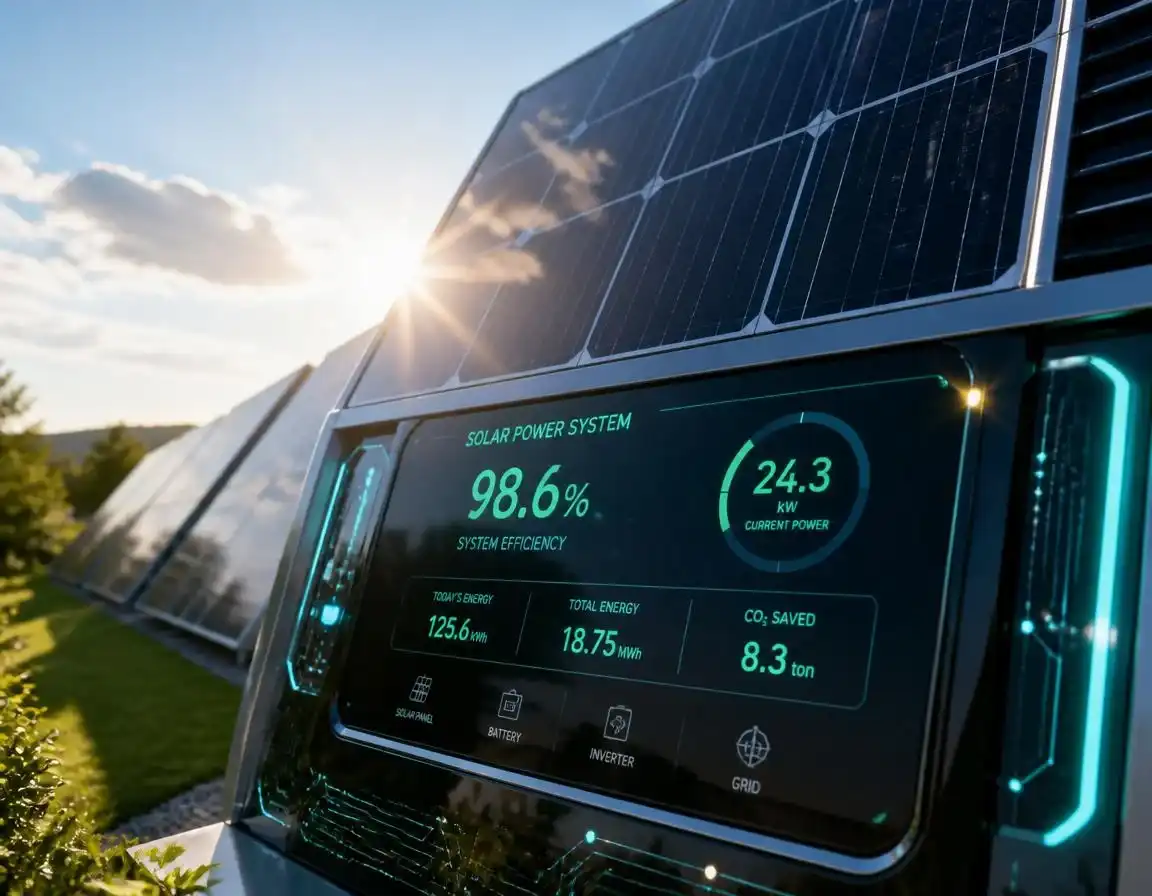
A good monitoring system shows you real-time generation, consumption, battery status, and export — via an app. In 2026, the best systems use AI to optimise your energy use automatically.
Most modern inverters and batteries include some level of monitoring. But there’s a big difference between basic displays and full energy management platforms.
Basic monitoring (included with most inverters):
- Current and historical generation
- Total kWh generated
- Basic fault alerts
Advanced monitoring (Sigenergy, GivEnergy, SolarEdge):
- Real-time consumption vs generation
- Battery charge level and rates
- Grid import and export
- Individual panel monitoring
- AI-powered weather forecasting
- Automated load shifting to solar hours
Real-Time Dashboard
See exactly how much power your panels are generating, how much your home is using, and where every watt is going.
Battery Management
Monitor charge levels, set schedules, and see exactly when your battery is saving you money.
AI Forecasting
Predict tomorrow’s solar generation based on weather and automatically optimise battery charging.
Tariff Optimisation
Automatically charge from cheap overnight electricity and discharge during expensive peak hours.
Alerts & Diagnostics
Instant notifications if a panel underperforms or your system stops generating.
Monitoring Systems Compared
- Sigenergy SigenStor★★★★★
- GivEnergy Portal★★★★☆
- SolarEdge Monitoring★★★★☆
- Enphase Enlighten★★★★☆
- Tesla App★★★☆☆
- Basic Inverter Display★★☆☆☆
Solar Technology FAQ
Quick answers to the questions we get asked most about solar technology in the UK.
For most UK homes with a south-facing unshaded roof, a string inverter is the most cost-effective choice. If you plan to add battery storage now or later, choose a hybrid inverter — it manages panels, battery, and grid connection in one unit. For roofs with shading, dormer windows, or multiple orientations, microinverters are the better option as they optimise each panel independently. In 2026, the most popular UK brands are Solis, SolarEdge, GivEnergy, Sungrow, and Enphase. See our full solar inverter guide for a detailed comparison.
Solar roof tiles (BIPV) are worth considering if your roof is due for replacement anyway, or if you live in a conservation area where standard solar panels are not permitted. They are 50–150% more expensive than traditional solar panels and typically less efficient (14–20% vs 22–25.5% for N-type panels). However, they are a genuinely elegant solution if aesthetics matter and you’re already budgeting for a new roof. Leading UK-available options include Tesla Solar Roof, Marley SolarTile, and GB-Sol tiles. Expect to pay £20,000–£45,000 for a full roof replacement with integrated solar. Learn more about solar panel options to compare.
Yes — and it’s one of the most cost-effective things you can do with a solar system. A smart solar EV charger such as the myenergi Zappi detects when your solar panels are generating surplus electricity and automatically diverts it to charge your car for free. Zappi works in three modes: Eco (diverts surplus solar), Eco+ (waits for 100% solar before charging), and Fast (charges from the grid at full speed). A typical 4kW system can supply 60–80% of an average UK driver’s annual mileage in free solar electricity. Read our full solar and EV guide for more detail.
The best solar battery for most UK homes in 2026 is a Lithium Iron Phosphate (LFP) system. Top options include the Tesla Powerwall 3 (13.5kWh, around £8,500 installed), GivEnergy (5.2kWh–13.5kWh, from £3,800), FoxESS ECS series, and Sigenergy. LFP chemistry is safer, degrades more slowly, and lasts longer than older NMC lithium batteries. A typical 5–10kWh battery raises your self-consumption from around 30% to over 70%, and most systems pay back in 9–12 years including bill savings and Smart Export Guarantee income. See our complete battery guide.
An off-grid solar system generates and stores all the electricity a property uses without any connection to the National Grid. It typically consists of solar panels, a large battery bank (often 15–50kWh), a hybrid or off-grid inverter, and frequently a diesel or LPG backup generator for periods of prolonged low sunlight. Off-grid systems are most common in rural UK properties where grid connection costs are prohibitively high (often £20,000–£80,000+). They are viable in the UK but require careful sizing to cope with low winter sun. A full off-grid setup for a UK home typically costs £20,000–£60,000. Check realistic UK solar output figures before sizing your system.
A solar thermal system uses collectors on your roof to capture heat from the sun and transfer it — via a heat exchanger — to your hot water cylinder. Unlike solar PV panels, solar thermal doesn’t generate electricity; it heats water directly. A well-sized system can provide 40–60% of a typical UK household’s annual hot water, rising to 90–100% in summer months. A full installation typically costs £3,000–£5,000 and can save £150–£250 per year on gas bills. Solar thermal works particularly well alongside heat pumps and is eligible for 0% VAT until March 2027.
A solar diverter (also called a solar immersion diverter or solar export diverter) is a device that detects when your solar panels are exporting surplus electricity to the grid and automatically redirects that energy to heat your hot water instead. This effectively turns your immersion heater into a free solar-powered water heater. Without a battery, most homes export 60–70% of their solar generation. A diverter — such as the myenergi Eddi or the iBoost — costs £300–£500 installed and pays back in 1–3 years. It’s the cheapest way to raise self-consumption without buying a full battery system. Compare with battery options in our storage guide.
A solar carport is a purpose-built canopy structure above a parking area that supports solar panels on its roof. It provides covered parking and generates solar electricity simultaneously. In the UK, solar carports are popular for driveways, commercial car parks, and agricultural properties. Domestic solar carports typically cost £8,000–£20,000 and qualify for 0% VAT. They are particularly useful where the main roof is shaded, north-facing, or already at full capacity. Planning permission may be required for larger structures. Consider this option if you’re also looking at flat roof or ground-mount solar.
A solar monitoring system tracks the real-time generation, consumption, and export of your solar setup via sensors and a dedicated app. Good systems — like those from Sigenergy, GivEnergy, or SolarEdge — show you exactly how much energy your panels are producing, how much your household is consuming, how much is going to your battery, and how much is being exported to the grid. Advanced systems use AI to forecast weather, pre-charge batteries from cheap overnight tariffs, and automatically shift household loads to solar hours. Most modern inverters and batteries include monitoring as standard. It’s an essential tool for maximising your solar panel return on investment.
Ready to Choose Your Solar Tech?
We’ve got detailed guides on every technology covered here — with real UK prices, installer recommendations, and honest advice.