
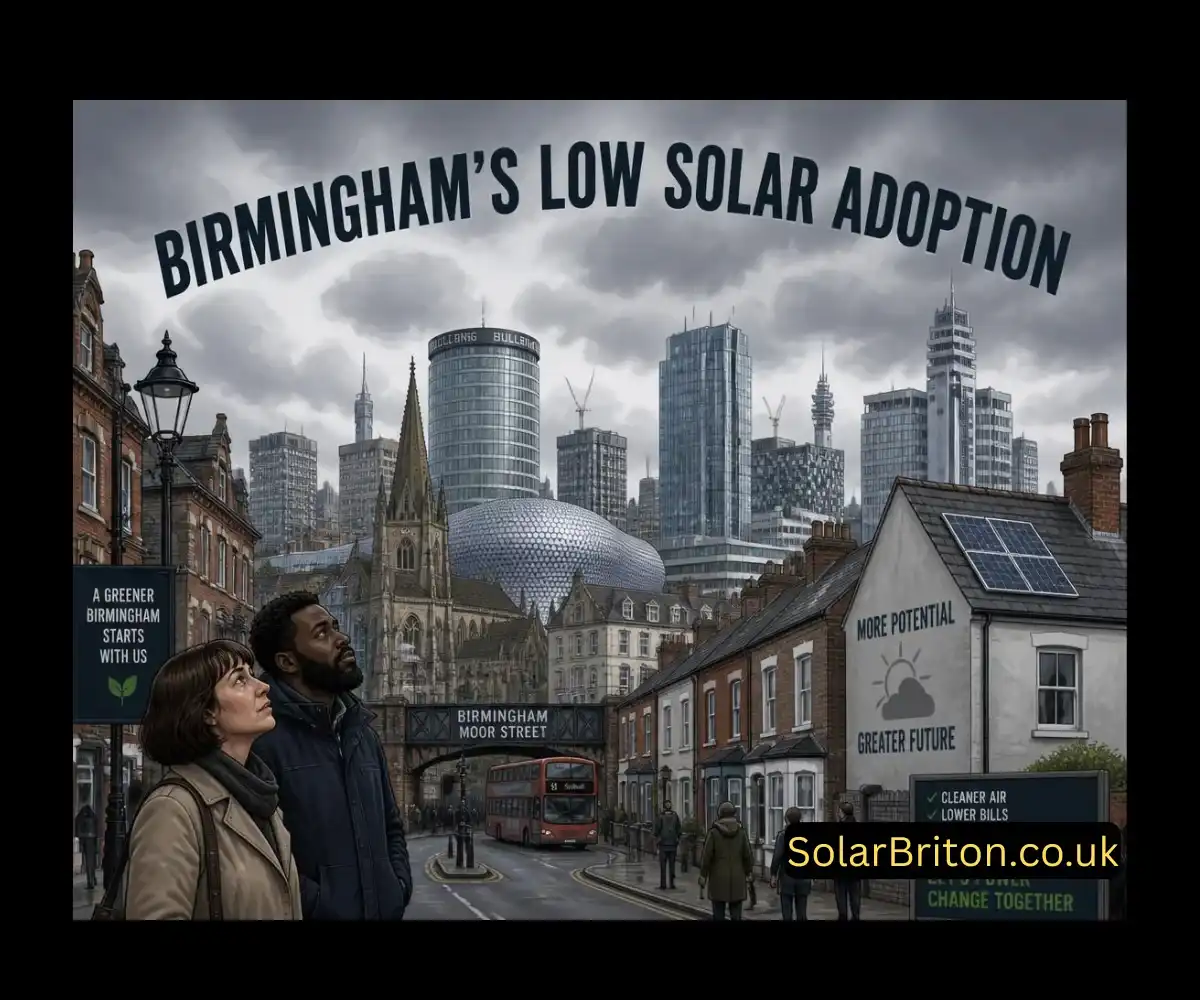
Why Birmingham Has the Lowest Solar Adoption in England

Birmingham · Solar Energy · Updated 2026
Why Birmingham Has the Lowest Solar Adoption in England — and Why That Should Change
Birmingham gets more sunshine than people give it credit for. So why are so few of its rooftops actually using it?
Ask someone what Birmingham’s famous for and solar panels probably won’t make the list. Canals, the Bullring, Cadbury, the accent — sure. Rooftop solar, not so much. But here’s a number that might catch you off guard: Birmingham is England’s second city, home to well over a million people and more than 420,000 households, and it has one of the lowest rates of solar panel adoption of any major city in the country. While homes in Cornwall and South Cambridgeshire are powering themselves with sunshine at rates approaching one in five, Birmingham is sitting a long way back. We dug into the latest government figures to find out why — and to look at what’s actually changing in 2026.
Check out how many solar panels are required in the U.K. Government data analysed by E.ON UK puts Birmingham at 13,328 solar panel installations across roughly 423,500 households — an adoption rate of just over 3%. That’s a strange position to be in, because Birmingham actually ranks 10th in the whole country for the total number of solar panels installed. The issue is that with so many households, those installations get spread thin. Leeds, the next big city on the list, manages around 4%. The South West of England, as a region, sits at 8.5%. And in Cornwall, the figure is closer to 12%. Of every English area in the UK’s top 15 locations for total solar installations, Birmingham comes out lowest on the number that actually matters: the share of homes using it. Source: GOV.UK / MCS-certified installation data, analysed by E.ON UK, March 2026. Ranks shown are positions within the UK’s top 15 areas by total solar installations. Source: GOV.UK data analysed by E.ON UK, March 2026.Birmingham’s Solar Numbers: Where the City Really Stands
Rank Area Households Installations Adoption rate 1 Cornwall 250,500 31,024 12.4% 2 Somerset 250,100 24,603 9.8% 9 Leeds 341,500 13,417 3.9% 10 Birmingham 423,500 13,328 3.1% 14 South Cambridgeshire 67,000 11,862 17.7%
Check out Best SEG Tariff Rates UK It’s not down to a lack of sunshine — Birmingham gets a perfectly reasonable amount of it, comparable to plenty of cities with much higher adoption rates. The real story is about housing and household budgets. Start with the roofs. Almost 30% of homes in Birmingham are terraced, well above England’s 24% average, and a quarter are flats — both property types that are far trickier to fit with solar than a detached or semi-detached roof. Only 11% of Birmingham’s housing is detached, about half the national average. Add a sizeable private rental sector into the mix, and you’ve got a city where a lot of residents simply can’t make the call to install solar themselves, even if they wanted to — that decision sits with a landlord who often has little financial reason to say yes. Source: Birmingham City Council Housing and Economic Development Needs Assessment. Then there’s money. Birmingham’s fuel poverty rate stands at 13.8%, one of the five highest of any local authority in England, according to the latest government figures. That’s precisely the group of households who’d benefit most from lower electricity bills, and precisely the group least likely to have several thousand pounds spare for the upfront cost. Throw in 29 conservation areas covering some of Birmingham’s most distinctive neighbourhoods, like Moseley and the Jewellery Quarter, where extra planning rules can apply, plus a council that’s spent the past two and a half years rebuilding its finances after a 2023 budget crisis, and the picture starts to make sense.So Why Has Solar Uptake Stayed So Low in Birmingham?
housing mix
Check out Solar Panel Grants U.K. Here’s the thing: the timing has rarely been better. The UK passed 2 million total solar installations for the first time in March 2026, and 2025 was the strongest year on record for solar, with a new rooftop installation completed somewhere in the country roughly every two minutes. Rooftop solar can now save a typical household up to £480 a year, and the government’s working towards more than doubling total UK solar capacity by 2030. From this year, new homes built in England must include solar panels as standard under the Future Homes Standard — which matters hugely for Birmingham, a city building thousands of new homes annually. For a city with Birmingham’s fuel poverty numbers, solar isn’t a lifestyle extra.The Case for More Solar Panels in Birmingham
It’s one of the few home upgrades that quietly pays for itself, year after year.
Check out the Best Solar Battery in the UK The good news is the city isn’t standing still. Birmingham City Council runs Switch Together Birmingham, a free group-buying scheme that pools residents together to get competitive quotes on solar panels and battery storage from vetted installers, with no obligation to go ahead once you see your offer. Lower-income households may also qualify for the Warm Homes: Local Grant, worth up to £15,000 towards solar and home insulation. For most properties, you won’t even need planning permission, since solar panels count as permitted development in Birmingham, unless your home sits in one of the city’s conservation areas or is a listed building. With 0% VAT on solar installations still running until March 2027, there’s rarely been a cheaper moment to find out what your own roof could be doing.How Birmingham Residents Can Get Solar Panels in 2026
Check out Solar panels for caravan Birmingham doesn’t lack sunshine, ambition, or rooftops. What it’s lacked is momentum. With national investment rising, local schemes up and running, and energy bills only heading one way, the lowest solar adoption rate in England looks less like a permanent fact about Birmingham and more like a gap that’s genuinely starting to close, one roof at a time. Birmingham’s housing stock is a big part of it. Almost 30% of homes are terraced and a quarter are flats, both far harder to fit with solar than a detached roof, and only 11% of homes are detached. A large private rental sector and a fuel poverty rate of 13.8%, among the highest in England, add to the gap, since upfront cost is the biggest barrier for the households who’d benefit most. Usually not. Solar panels are classed as permitted development in Birmingham, so most homeowners can install them without applying for planning permission, as long as panels don’t protrude more than 200mm from the roof. The main exceptions are properties in one of Birmingham’s 29 conservation areas or listed buildings, where permission may be needed. Birmingham City Council runs Switch Together Birmingham, a free group-buying scheme offering competitive quotes from vetted installers. Lower-income households may also qualify for the Warm Homes: Local Grant, worth up to £15,000. Solar installations also currently benefit from 0% VAT, which is due to run until March 2027.Frequently Asked Questions
Why does Birmingham have such low solar panel adoption?
Do I need planning permission for solar panels in Birmingham?
How can I get solar panels in Birmingham in 2026?

2 Comments