Can I Get Free Solar Panels in the UK in 2026?

Can I Get Free Solar Panels in the UK in 2026?
There’s a lot of misleading information out there about this. So let’s be honest with you upfront: free solar panels exist — but only for households that qualify. This guide tells you exactly who does, which schemes are real, and how to apply without getting scammed.
The honest truth about “free solar panels”
Here’s something a lot of websites won’t tell you straight away: there is no scheme offering free solar panels to every UK homeowner. If you’ve been seeing adverts on social media or getting cold calls claiming otherwise, those are either misleading or outright scams.
That said — free solar panels genuinely are available in 2026, and thousands of UK households are getting them right now. The key is whether you qualify. The schemes are specifically designed for people on lower incomes, certain benefits, or living in fuel poverty. If that’s you, there has rarely been a better time to apply.
And even if you don’t qualify for a fully funded installation, the 0% VAT relief and the Smart Export Guarantee (SEG) mean everyone going solar in 2026 gets a better deal than they would have even three years ago. If you’re looking to invest outright, check out our guide on solar panel costs in the UK to see typical return on investment.
We’ve done the research across every scheme currently running in the UK. Here’s what’s actually available — with no fluff, no spin, just the facts.
Every UK solar grant and scheme at a glance (2026)
Here’s a comparison of every scheme currently available to help you go solar for free — or at a reduced cost — in the UK. We’ve included the eligibility requirements and a sense of the maximum value for each. For a deeper dive into hardware, you can also cross-reference our list of the best solar panels in the UK for 2026.
| Scheme | Type | Region | Who it’s for | Income limit | Max value |
|---|---|---|---|---|---|
| ECO4 Closes 31 Dec 2026 | Free grant | England, Scotland, Wales | Benefits claimants & fuel-poor households (EPC D–G) | £31,000 (LA Flex) or qualifying benefits | 100% of install cost |
| Warm Homes Local Grant England only, running now | Free grant | England only | Homeowners & private renters (EPC D–G) | ~£36,000 (varies by council) | Up to £15,000 |
| NEST Scheme Wales only | Free grant | Wales only | Low-income households (EPC E or below) | £38,456 | 100% of install cost |
| Warmer Homes Scotland | Free grant | Scotland only | Fuel-poor homeowners & private tenants | Means-tested | Free upgrades (varies) |
| Home Energy Scotland Loan | Interest-free loan | Scotland only | Homeowners (income <£36k) | £36,000 | £6,000 (solar PV) |
| Green Homes Wales | Loan + 30% grant | Wales only | All Welsh homeowners | None | £25,000 loan + grant |
| 0% VAT Relief Until March 2027 | Tax relief (everyone) | UK-wide | All residential homeowners | None | £1,000–£2,000 savings |
| Smart Export Guarantee | Ongoing payment | England, Scotland, Wales | All solar panel owners with MCS install | None | £150–£350+ per year |
| Solar Together / Switch Together | Group buying discount | Selected councils | All homeowners in participating areas | None | 20–37% off retail price |
ECO4: The UK’s main free solar scheme — and it closes this year
The Energy Company Obligation 4 (ECO4) is the most significant route to genuinely free solar panels in the UK right now. It was originally due to close in March 2026 but was extended by nine months on 23 January 2026 — meaning it now runs until 31 December 2026. You can read our comprehensive breakdown of the scheme on our ECO4 Guide page.
Here’s something important: the government has confirmed there will be no ECO5. This is the final iteration of the Energy Company Obligation. Once December 2026 arrives, this route to free solar closes permanently. If you think you might qualify, the time to check is now — not in October.
Energy suppliers have regional budget allocations and targets. Even though ECO4 officially runs until December 2026, funding in your area could be exhausted before then. Don’t leave it late.
How ECO4 works
ECO4 isn’t funded by the government directly. Instead, the UK’s largest energy suppliers are legally required by Ofgem to meet carbon reduction targets — and they do that by funding energy efficiency improvements in eligible homes. That means you don’t apply to the government; you apply via your energy supplier or through an MCS-certified installer who works with the scheme.
In many approved cases, ECO4 covers 100% of the installation cost, including the solar panels, mounting equipment, inverter, and installation labour. You could genuinely get a full solar system at zero cost.
Who qualifies for ECO4?
There are two main routes into ECO4:
✅ Route 1 — Qualifying Benefits
- Universal Credit (below income threshold)
- Pension Credit (Guarantee or Savings)
- Child Tax Credit
- Working Tax Credit
- Income Support
- Income-based Jobseeker’s Allowance
- Income-related Employment & Support Allowance
- Housing Benefit
✅ Route 2 — LA Flex (No Benefits Needed)
- Household income below £31,000
- Referred by your local authority
- May include health conditions, age vulnerability, or fuel poverty
- Property must still have EPC rating of D, E, F, or G
- Available to homeowners and private tenants (with landlord consent)
- EPC rating of D, E, F, or G (check yours at epcregister.com)
- Suitable roof — right orientation, minimal shading, structurally sound
- Solar is typically funded as part of a wider energy improvement package (e.g., alongside insulation)
Warm Homes Local Grant: England’s biggest new scheme
Launched in January 2026 as part of the government’s wider Warm Homes Plan, the Warm Homes Local Grant is genuinely the most valuable solar grant available in England right now. It’s not limited to benefits claimants — you could qualify purely on income.
The grant covers up to £15,000 of free home energy upgrades per household, including solar panels, battery storage, insulation, and heating improvements. For off-grid or higher-cost properties, local councils have some flexibility to exceed this. Unlike ECO4, this is fully funded by the government (not energy suppliers), and you apply through your local council.
Who qualifies?
The income threshold varies by council. Most use a figure of £31,000–£36,000, but some go as low as £23,000 (Newcastle) and others up to £38,000 (Isle of Wight). Your first step is checking your local council’s specific rules at gov.uk/apply-warm-homes-local-grant.
The Warm Homes Local Grant is available in England only. Scotland and Wales have their own equivalent programmes — see the sections below.
What’s available in Scotland and Wales?
Solar support varies quite a bit across the four nations. Here’s a quick breakdown of what’s available in Scotland and Wales:
You don’t need to qualify for a grant to save money
Even if your income is above the means-tested thresholds, going solar in 2026 is significantly cheaper than it used to be — thanks to three things that are available to every UK homeowner.
1. 0% VAT on solar panels (until March 2027)
Since April 2022, the government has applied zero VAT to solar panels, battery storage, and installation on residential properties. This relief is confirmed until 31 March 2027, and it’s available to everyone — no application, no income check.
On a 4kW system priced at £7,800, you save around £1,560 compared to the standard 20% VAT rate. On a combined solar and battery system at £12,000, that’s £2,400 in your pocket just from not paying VAT. It’s not “free solar,” but it’s a meaningful saving that reduces the payback period on any system you buy. To see how this affects your bottom line, try our dedicated Solar Savings Calculator.
2. Smart Export Guarantee (SEG)
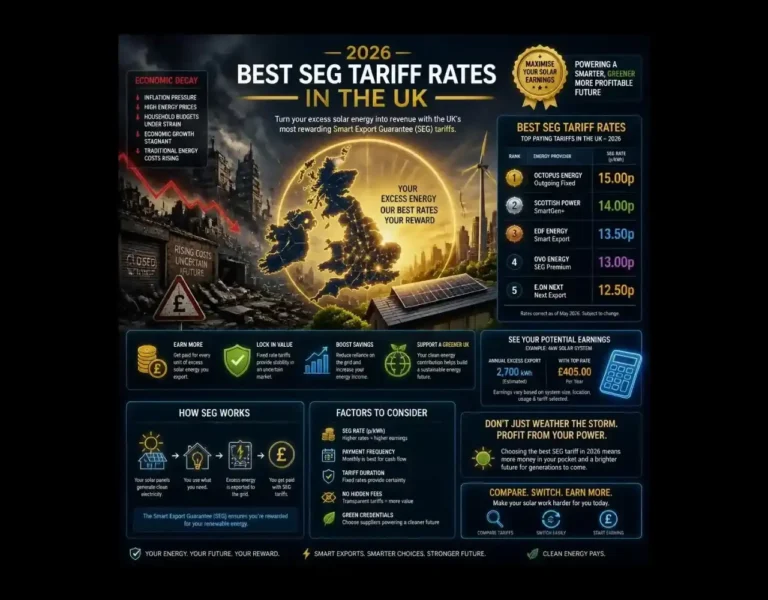
The Smart Export Guarantee pays you for every unit of surplus solar electricity you send back to the national grid. The scheme is mandatory for large energy suppliers, but the rates they offer vary — sometimes significantly.
As of July 2026, the standout rates we’ve tracked include Octopus Outgoing Agile at up to 27p/kWh (variable, tracking wholesale prices), with several other suppliers in the 12–20p/kWh range. Shopping around for the best SEG tariff can add £150–£350 per year to your returns, depending on your system size and how much you export.
One important requirement: your installer must be MCS-certified for you to access the SEG. This is something you should confirm before signing any installation contract — and it’s easy to check at mcscertified.com.
3. Solar Together (group buying — 20–37% off)
Solar Together (now rebranded as Switch Together in many areas) is a council-organised group buying scheme. Hundreds of homeowners in a local authority area register their interest, and vetted suppliers then compete in an auction for the bulk contract — passing the savings on to you.
The Greater London Authority has documented savings of 20–37% off retail price through this route. A 4kW system retailing at £7,500 might come down to around £4,700–£6,000 through Solar Together. There’s no means test — it’s open to all homeowners in participating areas. Check whether your council participates at sola.ichoosr.com.
* Figures are illustrative. Your quote will depend on system size, roof type, and location. Solar Together savings vary by area and auction outcome. Grant eligibility is means-tested.
How to apply for free solar panels: step by step
If you think you might qualify for ECO4, the Warm Homes Local Grant, NEST, or any other scheme, here’s the process from start to finish. It’s more straightforward than most people expect.
Check your EPC rating
Most free solar schemes require your property to have an EPC rating of D, E, F, or G. Look yours up for free at epcregister.com. If your property doesn’t have a current EPC, you can arrange an assessment for around £60–£120 through an accredited energy assessor.
Check your benefits or household income
For ECO4: check whether you or someone in your household receives a qualifying benefit (see the list earlier in this article). For the Warm Homes Local Grant: check that your combined household income falls below your local council’s threshold — usually £31,000–£36,000. For NEST (Wales): the income threshold is £38,456.
Choose your application route
ECO4: Contact your energy supplier’s ECO team directly, or approach an MCS-certified installer who handles ECO scheme referrals. Warm Homes Local Grant: Visit gov.uk/apply-warm-homes-local-grant and enter your postcode. NEST (Wales): Visit nest.gov.wales. Scotland (HES): Call 0808 808 2282 or visit Home Energy Scotland.
Book a free home survey
If you’re eligible, an approved installer will survey your home for free to confirm suitability and recommend the right measures. They’ll check your roof orientation, structural capacity, shading, and whether solar makes sense for your property. You’re under no obligation at this stage.
Verify the installer’s credentials
Before you agree to anything, check that the installer is MCS-certified (mcscertified.com) and TrustMark-registered (trustmark.org.uk). For ECO4, they should also be able to confirm their Ofgem registration. This takes two minutes and protects you from rogue traders.
Get at least three quotes
Even for grant-funded installations, you have the right to compare offers. Some energy suppliers may ask you to contribute to the cost; others may not. Getting multiple quotes could save you money, or help you negotiate a better package. If you’re looking for approved installers, check out our MCS installer directory.
🚨 Scam watch: how to protect yourself
Solar panel scams are, unfortunately, rampant in the UK. We’ve seen a big uptick in fraudulent cold calls, fake social media ads, and rogue traders as the end of ECO4 approaches. Here’s what to look out for — and what to do if something doesn’t feel right.
🔴 Red flags — walk away if you see these
- Cold callers claiming “the government is giving free solar to everyone“
- Social media ads promising panels regardless of income or benefits
- Companies asking for upfront cash to “register you on the grant”
- High-pressure tactics: “this offer ends today only”
- Anyone claiming to offer ECO4 work after 31 December 2026
- Letters or emails claiming to be from MCS offering maintenance packages (MCS doesn’t do this)
- Callers claiming your panels have a “voltage fault” requiring immediate expensive work
🟢 What legitimate schemes look like
- Apply via official channels (gov.uk, your energy supplier’s website, nest.gov.wales)
- No upfront fees — ever — for grant processing or registration
- Installer credentials are verifiable at mcscertified.com
- You’ll be given time to consider and compare options
- Any costs are clearly explained in writing before work starts
- Genuine installers are happy to wait while you verify their credentials
Report to Citizens Advice on 0808 223 1133 or Action Fraud at actionfraud.police.uk. Forward suspicious texts to 7726 (free, works on all networks). National Trading Standards has successfully prosecuted solar fraud firms — this is taken seriously.
What do solar panels actually cost in 2026 if you don’t qualify for a grant?
Genuinely — don’t write off solar just because you don’t qualify for a free installation. The economics are still compelling. Based on MCS-registered installation records from early 2026, here’s what you’re looking at. For a deeper breakdown of pricing variables, check out our detailed guide on Solar Panel Costs.
| System Size | Typical for… | Panels only | With battery | Est. annual saving | Payback period |
|---|---|---|---|---|---|
| 3kW | 1–2 bed home | £5,000–£6,500 | £8,000–£10,000 | ~£500–£650 | 8–12 years |
| 4kW | 2–3 bed home | £6,500–£8,500 | £10,000–£13,000 | ~£650–£850 | 7–11 years |
| 5kW | 3–4 bed home | £7,500–£10,000 | £11,500–£15,000 | ~£800–£950 | 7–11 years |
| 6kW | 4–5 bed home / EV | £9,500–£12,500 | £13,500–£17,000 | ~£900–£1,200 | 8–12 years |
All prices include 0% VAT (applied automatically to residential installations). Savings estimates based on Ofgem Q2 2026 unit rate of 24.67p/kWh plus SEG export income at 15p/kWh. Source: MCS installation data, Switch Together, FMB research. Payback periods assume South/Central UK location and average self-consumption of 45%.
A typical 4kW system bought outright in 2026 (no grant) returns an estimated £10,000–£20,000 profit over 25 years — that’s after the initial cost is fully recovered. That’s before you factor in energy price inflation, which has averaged 5–7% annually over the past decade.
What happens when ECO4 ends in December 2026?
This is the question we’ve been getting asked most lately — and the honest answer is that there’s still some uncertainty.
What we know for certain: there will be no ECO5. The government has been clear about this. The Energy Company Obligation ends with ECO4. What replaces it is the Warm Homes Plan — a £15 billion programme described by the government as “the biggest energy efficiency initiative in British history.”
The Warm Homes Local Grant (already running in England) will be the main grant route for low-income households. A separate Warm Homes Fund — offering low or zero-interest loans to all homeowners regardless of income — is expected to launch in late 2026 or early 2027, though the exact terms and application process haven’t been confirmed yet. For Wales, the Green Homes Wales scheme is already offering attractive interest-free loans up to £25,000.
Analysts and housing charities have flagged a potential gap between ECO4 ending (December 2026) and the Warm Homes Fund loans beginning (possibly 2027). If you’re on the fence about applying for ECO4, the safest advice is: apply now, don’t wait to see what comes next.
Frequently asked questions
Here are the questions we get asked most often about free solar panels in the UK. We’ve kept the answers honest and practical.
Can I get free solar panels in the UK in 2026?
Yes — if you qualify for a means-tested scheme. The main routes to genuinely free solar panels in 2026 are ECO4 (running until 31 December 2026, for households on qualifying benefits or with income below £31,000 via the LA Flex route), the Warm Homes Local Grant in England (up to £15,000 for households earning under roughly £36,000 with an EPC rating of D–G), and the NEST scheme in Wales (income under £38,456, EPC E or below).
There is no universal free solar panel scheme — all grant routes are means-tested. However, all UK homeowners benefit from 0% VAT on solar until March 2027, saving £1,000–£2,000.
Who qualifies for ECO4 free solar panels?
You may qualify if someone in your household receives a qualifying benefit — such as Universal Credit, Pension Credit, Child Tax Credit, Income Support, Housing Benefit, or income-based JSA/ESA — OR your household income is below £31,000 (referred via the LA Flex route by your local council).
Your property must also have an EPC rating of D, E, F, or G. Solar is typically installed alongside other improvements like insulation. ECO4 closes on 31 December 2026 — there’s no successor scheme announced.
What is the Warm Homes Local Grant?
The Warm Homes Local Grant is a government-funded scheme in England only, launched in January 2026. It covers up to £15,000 of free home energy upgrades — including solar panels, battery storage, insulation, and heating — for eligible households.
Eligibility requires: household income of £36,000 or below (varies by council — some as low as £23,000, some as high as £38,000), and an EPC rating of D, E, F, or G. Apply at gov.uk/apply-warm-homes-local-grant.
What happens after ECO4 ends in December 2026?
There will be no ECO5. The government has confirmed ECO4 is the final iteration of the Energy Company Obligation. From 2027, energy efficiency support will be delivered through the Warm Homes Plan, primarily via the Warm Homes Local Grant (already running in England) and a new Warm Homes Fund offering low or zero-interest loans to all homeowners (expected late 2026/early 2027, details still to be confirmed).
Some analysts warn there may be a gap in provision for some households. This is why acting on ECO4 now is important if you think you might qualify.
Are there free solar panel grants in Scotland?
Scotland doesn’t have a direct equivalent to the Warm Homes Local Grant. ECO4 applies across Scotland on the same criteria as England (closes 31 Dec 2026). Warmer Homes Scotland offers free upgrades to households in or at risk of fuel poverty.
Home Energy Scotland provides interest-free loans of up to £6,000 for solar PV — but note that HES solar grants were discontinued in June 2024. The loan scheme remains. Call 0808 808 2282 for a free, no-obligation assessment.
Are there free solar panel grants in Wales?
Yes. The Welsh Government’s NEST scheme provides free solar panel installations to eligible households with an income of £38,456 or below and an EPC rating of E or lower (or EPC D with an eligible health condition). Visit nest.gov.wales to apply.
Green Homes Wales offers interest-free loans of £1,000–£25,000 plus a grant covering up to 30% of costs for some measures. There’s no means test — any Welsh homeowner can apply through the Development Bank of Wales.
Is 0% VAT still available on solar panels in 2026?
Yes — and it’s one of the best bits of news for anyone going solar in 2026. Solar panels, battery storage, and installation labour all carry 0% VAT on UK residential properties. This is confirmed until at least 31 March 2027.
On a typical 4kW installation costing £7,800, you save £1,560 compared to the standard 20% VAT rate. On a solar + battery system at £12,000, that’s a £2,400 saving. No application required — it’s applied automatically by any registered installer.
How do I apply for free solar panels in the UK?
For ECO4: Contact your energy supplier’s ECO team, or approach an MCS-certified installer who handles ECO applications — they’ll assess your eligibility for free.
Warm Homes Local Grant (England): Go to gov.uk/apply-warm-homes-local-grant and enter your postcode.
NEST (Wales): Apply at nest.gov.wales or call 0808 808 2282.
Scotland: Call Home Energy Scotland on 0808 808 2282. Always verify any installer at mcscertified.com before agreeing to work.
How can I avoid solar panel scams?
The most important things to remember: no legitimate grant scheme ever requires an upfront fee for processing or registration. If anyone asks you to pay cash to “register on the scheme,” it’s a scam.
Be wary of cold callers, unsolicited social media ads promising “free panels for everyone,” and anyone claiming to offer ECO4 after December 2026. Always verify installers at mcscertified.com. Report suspected scams to Citizens Advice on 0808 223 1133 or at actionfraud.police.uk.
How much do solar panels cost in 2026 without a grant?
Based on MCS-registered installation records from early 2026, the average UK domestic solar system costs £8,677 (around £1,686 per kW). A typical 4kW system costs £6,500–£8,500 for panels only, or £10,000–£14,000 with battery storage.
All residential installations benefit from 0% VAT until March 2027, saving around £1,000–£2,000. With SEG payments and rising energy prices, most households recoup the cost within 7–12 years — leaving 15–20 years of near-free electricity after payback. Read our full guide on Solar Panel Costs for more details.
The bottom line
Free solar panels are real in 2026 — but they come with eligibility conditions. If you’re on a low income, claiming certain benefits, or in fuel poverty, you should absolutely check your eligibility for ECO4 and the Warm Homes Local Grant (or their Scotland and Wales equivalents) as soon as possible. ECO4 in particular closes for good in December 2026 with no successor confirmed.
If you don’t qualify for a free installation, that doesn’t mean solar is out of reach. The combination of 0% VAT (saving up to £2,400), Smart Export Guarantee payments, and falling panel prices means the economics of going solar have rarely been better for ordinary UK homeowners.
Whatever your situation — always get at least three quotes from MCS-certified installers, and always verify credentials at mcscertified.com before signing anything. If something sounds too good to be true, it probably is.
Use our free Solar Panel Savings Calculator to get a personalised estimate of your potential savings, recommended system size, and payback period — tailored to your home and location.
Disclaimer: This article is for informational purposes only and does not constitute financial or legal advice. Scheme details, eligibility criteria, and funding levels can change without notice. All data sourced from Ofgem, gov.uk, MCS, and scheme operators as of July 2026. Always verify current eligibility criteria directly with the relevant scheme before making any financial decisions. SolarBriton.co.uk is an independent information resource and is not affiliated with any grant scheme or energy supplier.


One Comment