Are Chinese Solar Panels Safe in the UK? – Claude Ready

Are Chinese Solar Panels Safe in the UK? The Honest 2026 Answer
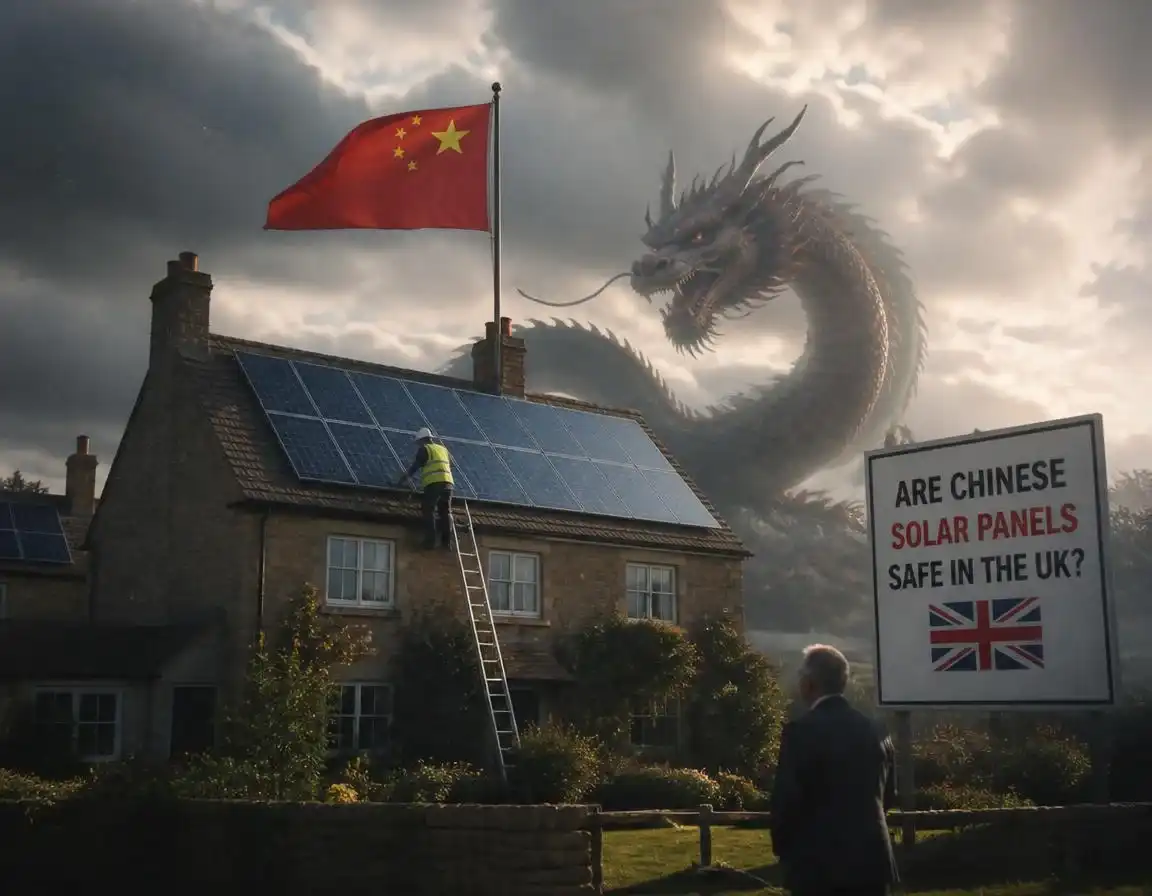
Roughly two in three panels on British roofs were made in China. So are they safe on your house — electrically, in a fire, and ethically? I’ve dug through the certification paperwork, the latest fire statistics and parliamentary reports so you don’t have to.
The 30-second answer
- Electrically and structurally, yes. Chinese panels sold through reputable UK installers pass the same international safety tests as any other panel — IEC 61215 (design) and IEC 61730 (electrical & fire safety) — and must be installed to UK wiring rules (BS 7671) by an MCS-certified installer.
- The fire risk is about the installation, not the passport. UK fire services attended 212 solar-related fires in 2025 out of just over 2 million UK installations — a roughly 1-in-9,600 chance per system, and the leading identified cause was DC cabling and connectors, not where the panel was built.
- The honest concerns are ethical and quality-tiering. Up to 68% of UK panels come from China, and a big slice of the world’s polysilicon passes through the Xinjiang region with its documented forced-labour concerns. That’s checkable too — more below.

Why China dominates your roof (and everyone’s)
Let’s start with the scale of it, because it explains everything else. China controls more than 80% of the world’s manufacturing capacity at every stage of the solar supply chain, and customs data cited in Parliament and industry analysis puts over 40% of the UK’s solar PV equipment imports — and as high as 68% for panels specifically — as Chinese-made. We covered the full breakdown in our piece on China’s solar supply chain and forced labour.
Here’s the thing: “made in China” is no longer a quality statement in either direction. The biggest Chinese factories are among the most automated in the world, and the same production lines supply premium European brands. The question isn’t the country — it’s which tier of factory your panel came from, and that’s exactly what the rest of this guide helps you check.
Fire risk: the real numbers, not the headlines
I know what you’re thinking: “212 fires in a year sounds a lot.” It does — until you put it against just over 2 million installations, which makes solar one of the safest electrical additions you can put on a house, even though the fire count has risen 133% since 2022 (more than double the 52% growth in installations over the same period, according to insurer QBE’s FOI-based analysis). The official GOV.UK fire statistics back this general picture up.
And here’s the crucial bit for this debate: QBE’s own cause breakdown for 2025 puts DC cabling and connectors as the single leading identified cause (49 incidents), ahead of the panel itself (36), battery banks (23) and inverters (19) — not the country the panel was manufactured in. A certified panel badly installed is dangerous; a certified panel well installed is boringly safe. That’s why the installer matters more than the flag on the box (and why our battery fire-safety guide hammers the same point).
The certifications that actually make a panel safe
Safety in the UK doesn’t come from trust — it comes from paperwork. Every panel legally installed on a British home should clear this ladder:
| Standard / rule | What it proves | How you check it |
|---|---|---|
| IEC/BS EN 61215 | Design qualification — survives thermal cycling, damp heat, hail, mechanical load | Printed on the datasheet & certification certificate |
| IEC/BS EN 61730 | Electrical & fire safety qualification (shock, arc, fire rating) | Datasheet + independent certifier (TÜV, Kiwa, UL) |
| IEC 61701 | Salt-mist corrosion testing — vital for coastal properties | Ask for it if you live within ~5 km of the sea |
| UKCA / CE marking | Legal market-access marking for the UK | On the panel label itself |
| BS 7671 wiring regs | Installation safety — cabling, isolation, earthing | Your installer’s electrical certificate at handover |
| MCS certification | Installer + product standards; required for SEG export payments | Installer’s MCS number, checkable on the MCS website |
Chinese-made panels from the major brands carry all of these — they’re tested by the same independent bodies (TÜV Rheinland, Kiwa, etc.) as German or Korean panels. The MCS scheme and the Smart Export Guarantee effectively gatekeep uncertified kit off UK roofs, which is your first big safety net.
Tier 1, PVEL and the quality games brands play
“Tier 1” gets flashed at you in every quote, so let’s deflate it politely: the BloombergNEF Tier 1 list is a bankability snapshot for big solar farms — not a quality score for your semi in Leeds. The list tightened sharply (qualifying project size rose from 1.5 MW to 10 MW by mid-2025), shrinking from 40+ manufacturers to roughly 20, and even Jinko was briefly dropped once over a minor subsidiary legal dispute. We explain this in depth in our Jinko vs JA Solar vs Trina comparison.
A sharper tool for homeowners is the Kiwa PVEL Module Reliability Scorecard, which independently stress-tests panels through thermal cycling, damp heat, hail and degradation. Jinko has been named a Top Performer for 12 consecutive years; Trina is a consistent Top Performer too. Combined with N-type TOPCon technology (1%/0.4% per-year degradation, 87.4% output guaranteed at year 30), the top Chinese brands are genuinely world-class.
The forced labour question — the part nobody can shrug off
This is where “safe” stops being only about electrons. Polysilicon is the core ingredient in around 95% of panels sold today, China produces roughly half the world’s supply, and an estimated 42–45% of the global total comes from the Xinjiang region, where the UN and multiple investigations (including Sheffield Hallam University’s Helena Kennedy Centre for International Justice) have documented forced-labour concerns involving Uyghur workers. Our full investigation is in China’s solar supply chain and forced labour.
How the world is responding in 2026:
| Who | Action | What it means for you |
|---|---|---|
| 🇺🇸 United States | UFLPA — presumes Xinjiang goods are forced-labour made and blocks them at the border | Diverted stock can end up seeking other markets (like ours) |
| 🇬🇧 UK | Great British Energy banned from using forced-labour-linked solar panels (Great British Energy Bill amendment, 2025); several UK county councils have written directly to the government urging a full import ban on projects in their areas | State projects must now audit supply chains — see the Parliament committee report |
| 🇪🇺 EU | Forced Labour Regulation in force; plus a June 2026 move to bar EU funding for projects using inverters from “high-risk countries” | European-audited supply chains are tightening further |
| 🌐 Industry | Solar Stewardship Initiative (SSI) — independent, third-party-audited (TÜV Rheinland) ESG & traceability certification, at factory-site level | The practical check you can actually use today |
Note that last row carefully: SSI certification applies to specific factory sites, not whole companies. Trina, Jinko, Canadian Solar and LONGi all hold SSI certification at named sites — so the question to ask your installer is “which factory site will my panels come from, and is it SSI-certified?” A good installer can answer; a dodgy one can’t even spell it.
UK rules in 2026: your built-in safety nets
Buy through this chain and the origin of the panel becomes almost irrelevant to safety: MCS installers can only fit certified products, the installation must comply with Building Regulations and BS 7671, and you’ll need the paperwork anyway to claim SEG export income and keep your home insurance valid. The risk lives in the shortcuts — cash deals, uncertified kit, “mate-of-a-mate” installs — which is exactly what our 7 red flags of solar scams guide helps you dodge.
The Chinese brands UK installers actually quote in 2026
These three turn up on most British quotes. Figures below match the mainstream residential panels currently circulating in the UK trade (prices ex VAT, per panel):
| Spec | Jinko Tiger Neo | JA Solar DeepBlue 4.0 Pro | Trina Vertex S+ |
|---|---|---|---|
| Cell tech | N-type TOPCon | N-type TOPCon (Bycium+) | N-type i-TOPCon, dual glass |
| Efficiency | 22.0–22.3% | 21.8–22.5% | 22.0–22.5% |
| Residential wattage | 420–480W | 415–460W | 425–450W |
| Product / performance warranty | 25 yr / 30 yr (87.4% @ Y30) | 25 yr / 30 yr (87.4% @ Y30) | 25 yr* / 30 yr (87.4% @ Y30) |
| Degradation (Y1 / per year) | 1% / 0.4% | 1% / 0.4% | 1% / 0.4% |
| Typical UK trade price | £45–£70 | £70–£110 | £85–£140 |
| Kiwa PVEL record | Top Performer 12 yrs straight | Regular participant | Consistent Top Performer |
*Some Trina Vertex S+ batches ship with a 15-year product warranty — always check the exact datasheet against your quote. Full reviews: Jinko Solar Panels Review UK 2026 and our best solar panels for UK homes roundup.
And don’t forget the other Chinese-made box on your wall: the inverter. The EU’s June 2026 move on high-risk-country inverters and the discovery of 93 security flaws in solar inverters (including popular Chinese brands) are worth reading before you choose — our Growatt vs GivEnergy vs SolaX verdict covers the safe picks.
Your 10-point buyer’s safety checklist
- 1Installer first: MCS-certified, in writing, with their number you can verify. This is 80% of your safety.
- 2Datasheet check: IEC/BS EN 61215 and 61730 printed on it, with an independent certifier (TÜV, Kiwa).
- 3UKCA/CE marking on the physical panel label.
- 4N-type TOPCon, not clearance P-type PERC stock.
- 5Kiwa PVEL Top Performer status for extra confidence.
- 6Ask the factory-site question: which site will my panels ship from, and is it SSI-certified?
- 7Warranty in writing: 25-year product / 30-year performance — and who honours it if the brand exits Europe (see what warranties actually cover).
- 8Coastal? Request IEC 61701 salt-mist test evidence.
- 9Check the cabling and connectors specifically — QBE’s 2025 data shows this is now the single leading cause of solar fires, so ask what DC connector brand is being used and how it’s routed.
- 10Handover pack: electrical certificate, MCS certificate, datasheets — needed for SEG and insurance, and tell your insurer the system is fitted.
Quick answers (the ones Google loves)
Are Chinese-made solar panels safe to install on a UK home?
Are Chinese solar panels linked to forced labour?
Which Chinese solar panel brands are safest for UK homes in 2026?
Related reading on Solar Briton
Bottom line? Chinese solar panels are as safe on a UK roof as any panel on Earth — when they arrive through the certified chain and get installed properly. The country isn’t the risk; the shortcuts are. Buy the paperwork, not the flag. ☀️