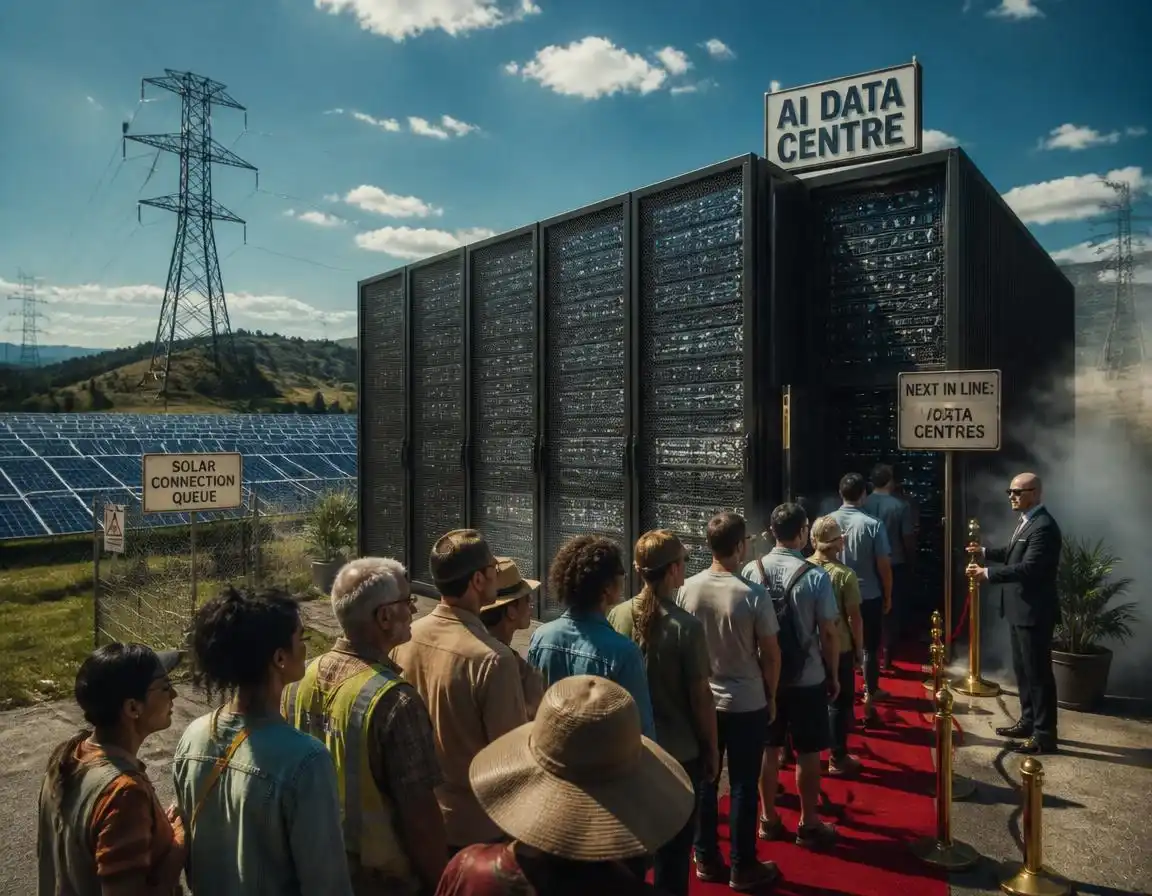
AI Data Centres Are About to Jump the Queue Ahead of Your Solar Connection

UK GRID CONNECTIONS · 2026 UPDATE
There's a very British kind of chaos happening in the electricity grid right now: everyone from housing developers to solar farms to AI data centres is queuing for the same scarce capacity, the queue has grown five and a half times longer in a year, and the government is now deciding who gets to skip to the front. Here's exactly what's going on, and whether it actually touches your own solar plans.
If you've ever waited months for a simple export meter upgrade, brace yourself — that's nothing compared to what's happening further up the food chain. Britain's electricity grid has a connections queue, and that queue has genuinely exploded. In November 2024, there was 41GW of demand waiting for a grid connection. By June 2025, that had rocketed to 125GW — more than double the UK's entire peak electricity demand of around 45GW. A huge chunk of that growth has one cause: AI data centres.
Now the government's response is landing, and it's not subtle. Ministers are drawing up a list of "strategically important" projects — AI Growth Zones chief among them — that will go straight to the front of the queue as capacity becomes available. Solar developers, community energy groups and ordinary households all watching their own connections crawl through the same overloaded system are, understandably, asking where that leaves them.
Data centres and solar farms technically sit in two separate grid queues — demand and generation — each with its own reform programme. But both are drawing on the same limited grid capacity, substations and engineering resource. The government is now proposing to let AI data centres and other "strategically important" projects skip ahead in the demand queue, at exactly the moment solar and battery projects are already facing serious delays of their own. It's not a literal single queue with data centres cutting in line ahead of a specific solar farm — it's two queues fighting over the same limited pie, with one side about to get a much bigger spoon.
The Scale Of It
How the queue got this big, this fast
To put the growth in context: Britain's entire electricity system peaks at around 45GW of demand on the coldest, darkest winter evenings. The queue of projects simply asking to connect to the grid is now nearly three times that.
NESO's own figures put around 73GW of that demand queue — roughly 315 separate projects — down to data centres alone, more than the entire country actually uses at peak. Ofgem itself admits a big part of the problem is speculative applications: developers piling into the queue "just in case," often for sites that may never actually get built, which clogs the system for everyone genuinely ready to connect. Only around 71 of the roughly 140 largest data centre projects tracked had reached a Final Investment Decision — meaning less than half were confirmed as real, funded, going-ahead projects rather than placeholders.
The Nuance Everyone Skips
Wait — is this literally the same queue as my solar farm?
Not quite, and it's worth being precise about this because a lot of coverage blurs it. There are technically two separate queues, each with its own reform programme.
Where AI data centres sit
- Covers projects that draw power from the grid: data centres, EV charging hubs, factories electrifying their processes
- Run under the "Demand Connections Reform" programme, led jointly by Ofgem, DESNZ and NESO
- This is where the "strategically important projects" fast-track list applies — the mechanism letting AI Growth Zones jump ahead
- Ofgem's latest proposal (July 2026) would charge data centre developers a Commitment Fee to weed out speculative applications
Where solar farms sit
- Covers projects that feed power into the grid: solar farms, wind farms, battery storage
- Run under TMO4+, the "first ready, first connected" reform Ofgem approved in April 2025
- Prioritises projects with planning permission, a Contract for Difference, or similar evidence they're genuinely progressing
- Even after reform, National Grid's own data shows solar and battery projects remain significantly oversubscribed against what's actually needed by 2030
So no, there isn't one master list where a data centre application literally slots in ahead of a named solar farm's paperwork. But both queues draw on the same finite substations, cables, transformers and network engineers to actually get built — and government handing one side of that equation a dedicated fast lane, its own reservation mechanism, and permission to build its own high-voltage infrastructure is capacity, investment and construction capability that isn't going toward unlocking the solar and battery projects still stuck behind grid constraints of their own.
How We Got Here
The timeline, from AI boom to grid gridlock
-
January 2025 — The AI Opportunities Action Plan
Government policy actively encouraged a wave of data centre construction to support UK AI ambitions — and applications for grid connections followed almost immediately.
-
April 2025 — TMO4+ approved for generation
Ofgem approved NESO's "first ready, first connected" reform for the generation queue, aiming to clear out non-viable solar, wind and battery applications and speed up genuine ones.
-
November 2025 — AI Growth Zones launched
The Department for Science, Innovation and Technology published its AI Growth Zones programme, identifying locations earmarked for accelerated data centre development.
-
March 2026 — The "strategically important" consultation
Government opened consultation on letting a defined list of projects — AI Growth Zones prominent among them — jump the demand connections queue as capacity is freed up.
-
April 2026 — A solar casualty, right on cue
RWE pulled the plug on a 99.9MW solar project in Wales, citing grid constraints — a concrete example of exactly the squeeze this article is about.
-
29 July 2026 — The Commitment Fee proposal
Ofgem published fresh plans for a Data Centre Commitment Fee, aimed at forcing developers to prove they're serious before holding a queue slot. Consultation runs until 16 September 2026.
Not Hypothetical
This is already showing up in real projects
Dropped in April 2026, with grid connection constraints cited directly as the reason — one of the clearest examples yet of a fully-fledged solar project failing to survive the current bottleneck, not just facing delay.
Solar Power Portal reported in February 2026 that Ofgem was frustrated at delays affecting the majority of projects that had already passed the reformed queue's Gate 2 readiness checks.
Three boroughs — Hillingdon, Ealing and Hounslow — were told there were no grid connections available for new developments of more than 25 homes, with the Greater London Authority pointing squarely at a local boom in data centres.
To be fair to the reform programme: Ofgem says earlier connections reforms have already brought forward 7.8GW of projects by an average of six years — proof the approach can work when it's not overwhelmed by speculative applications.
Reality Check
Does this actually affect your home solar panels?
Almost certainly not directly, and it's worth saying that plainly. If you're a typical homeowner installing a standard rooftop system, you're going through a "fit and inform" connection (known as G98), which doesn't touch this queue at all — your installer notifies the network operator after the job's done, rather than applying for capacity in advance.
Typical residential solar
- Standard rooftop systems under 3.68kW per phase (G98 "fit and inform")
- No advance grid application, no queue position, no interaction with this reform at all
- Installation timelines are governed by installer availability and equipment supply, not grid capacity
Larger or export-heavy setups
- Bigger residential or commercial systems needing a G99 application can hit local capacity limits in constrained areas
- Community energy schemes and solar farms are directly caught up in the generation queue squeeze described above
- New housing developments in data-centre-heavy areas (notably London and the South East) can face delayed connections that push back everything, including any solar the development was meant to include
Where this does touch every solar owner, even indirectly, is through the wider picture: roughly two-thirds of a typical household electricity bill goes toward network costs, not the electricity itself, and a grid struggling to keep pace with AI-driven demand affects how quickly the cheaper, cleaner system everyone was promised actually shows up — including how competitive export tariffs can be, and how fast new solar farm capacity gets added to the system as a whole. If you've been keeping an eye on other changes to solar-related government policy this year, it's worth reading alongside our piece on the Feed-in Tariff's move from RPI to CPI indexation — different mechanism, same underlying theme of the government reshaping the rules mid-stream as priorities shift.
The quick recap
- The UK's demand connection queue grew from 41GW to 125GW between November 2024 and June 2025 — nearly three times the country's entire peak electricity demand.
- Around 73GW of that is data centres, but under half of the largest projects have actually reached a Final Investment Decision — a lot of it may be speculative.
- Data centres (demand) and solar farms (generation) sit in technically separate queues, but both compete for the same limited grid capacity and engineering resource.
- Government plans would let "strategically important" projects, including AI Growth Zones, jump the demand queue as capacity frees up — while solar and battery projects remain heavily oversubscribed under their own reformed queue.
- Real casualties are already showing up, including a 99.9MW Welsh solar farm RWE dropped in April 2026 over grid constraints.
- Typical rooftop residential solar isn't part of this queue at all — the impact is mostly on solar farms, larger commercial systems, and the pace of the UK's wider clean power rollout.
❓ Common Questions
Frequently asked questions
Will AI data centres really jump ahead of solar farms for grid connections?
Not in a literal, single-queue sense — data centres sit in the demand connections queue, while solar farms sit in a separate generation connections queue, each with its own reform process. But the government is proposing to let "strategically important" projects, including AI Growth Zones, skip ahead in the demand queue, and both types of project draw on the same limited grid capacity and engineering resources — so faster progress for data centres can mean less capacity and investment left over for solar.
Does this affect my home solar panel installation?
For most homeowners, no. A typical rooftop system under 3.68kW per phase uses a "fit and inform" connection (G98) that doesn't involve the grid connection queue at all. This mainly affects larger commercial and export-heavy connections, community energy schemes, and utility-scale solar farms — plus, indirectly, the overall pace and cost of the UK's clean power rollout.
What is being done to fix the UK's grid connection queue?
Several reforms are running in parallel: TMO4+ (approved April 2025) prioritises "ready" generation projects like solar and battery storage; a separate Demand Connections Reform programme, led by Ofgem, DESNZ and NESO, aims to remove speculative data centre applications and prioritise strategically important ones; and a new Data Centre Commitment Fee, proposed in July 2026, would require developers to financially commit before holding a queue position.
Keep reading on SolarBriton
Policy & the bigger picture
Sources: GOV.UK, Clean Power 2030 Action Plan — connections reform annex; Ofgem, "Accelerating electricity network connections for strategic demand" consultation and Data Centre Commitment Fee consultation document (29 July 2026); NESO, electricity grid connection reform publications and Demand Queue Call for Input; National Grid Electricity Transmission, Connections Reform updates; Computer Weekly, The Register and Construction Enquirer coverage of the March 2026 "strategically important projects" consultation; Solar Power Portal and Rospower coverage of Gate 2 delays and the RWE Welsh solar project; Lexology and Norton Rose Fulbright legal briefings on TMO4+ and Demand Connections Reform. This article is for general information only and isn't investment, legal or planning advice — developers should check the live consultation documents on Ofgem's and NESO's websites for the latest position, as this is an actively moving policy area.