
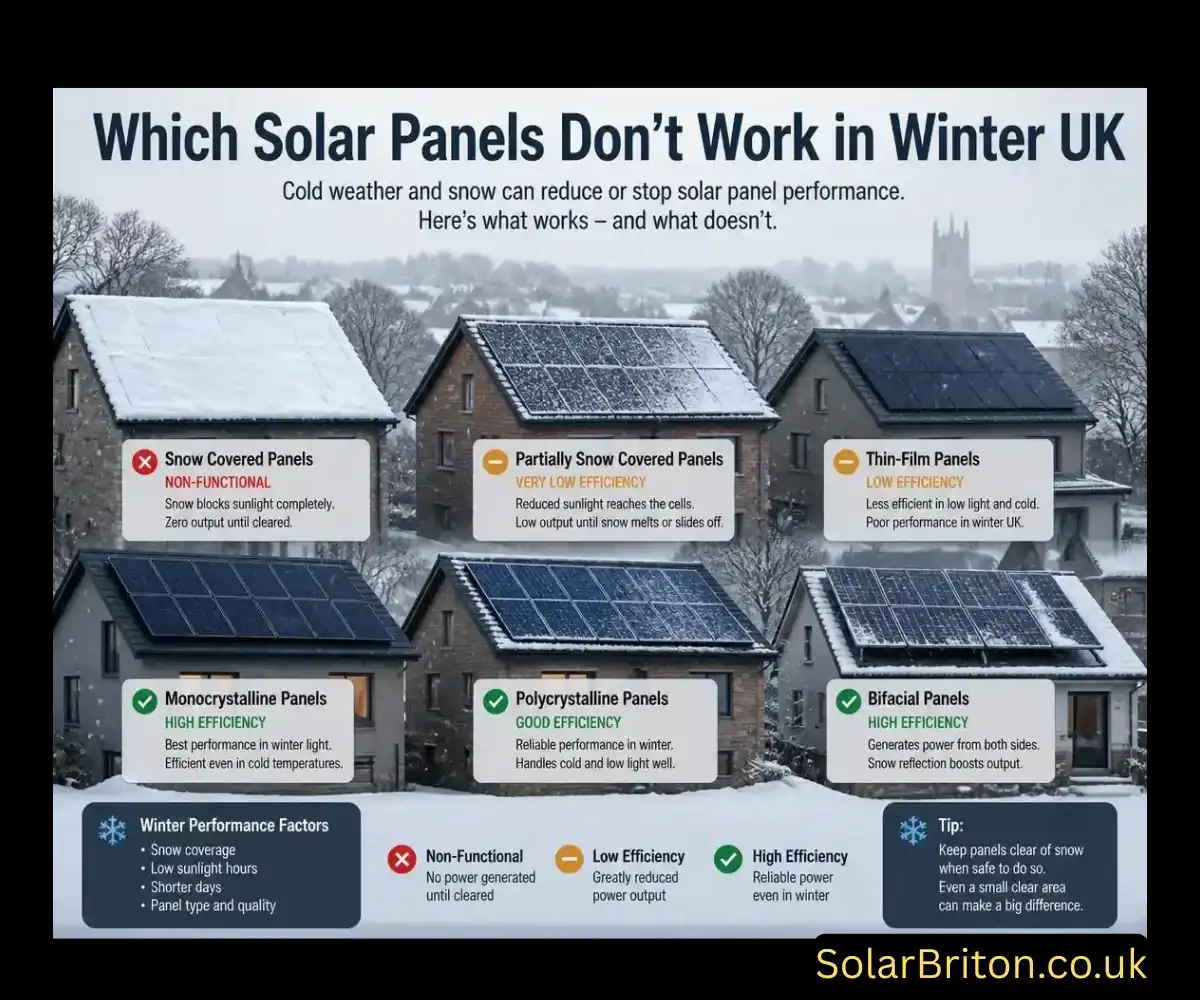
Which Solar Panels Don’t Work in Winter UK?

Do Solar Panels Work in Winter UK? 2026 Guide with Real Data
Is it true that solar panels work all year round in the UK? They run on daylight, not heat. What they don’t actually do is perform as well in December as they do in July. Here’s the real 2026 picture, with actual generation figures rather than vague reassurances.
A typical 4kWp UK system generates 3–6 kWh per day in winter versus 15–20 kWh/day in summer. Cold doesn’t stop panels — it helps slightly. Shorter days and a low sun angle are what cut winter output.
What a 4kWp System Actually Generates Each Month
The chart below shows approximate monthly generation for a 4kWp south-facing system in southern England. Notice the sharp dip from October onwards and the strong return from March.
Why Cold Weather Actually Helps Solar Panels
Here’s what most people get wrong: cold temperatures don’t reduce solar panel output — they improve it slightly. Solar cells are semiconductors that run more efficiently when cool. Panel efficiency increases by around 0.5% for every degree below 25°C, so a crisp, clear January day can actually produce more electricity per daylight hour than a scorching July afternoon.
What genuinely shrinks winter output is fewer daylight hours (7–8 in December versus 16–17 in June) and the sun sitting low in the sky, hitting panels at a shallower angle. Neither is about cold — it’s just geometry and calendar.
| Metric | July (Peak) | December (Lowest) |
|---|---|---|
| Daily output | 15–20 kWh/day | 3–6 kWh/day |
| Monthly total | ~430–460 kWh | 80–150 kWh |
| Daylight hours | 16–17 hrs | 7–8 hrs |
| Panel efficiency | Standard | Slightly higher |
| Share of annual output | ~38% (Jun–Aug) | ~11% (Nov–Feb) |
4kWp south-facing system, southern England average. Northern Scotland will see lower winter figures. Always check quotes from MCS-certified installers for localised estimates.
Proportion of a 4kWp system’s annual generation by season:
What About Snow and Frost?
In most of the UK, snow is rare enough that it barely matters. When it does settle on panels, the roof’s tilt usually helps it slide off within hours. A light frost clears as soon as the panels warm slightly in the morning light. You’d only lose meaningful generation if heavy snow fully covered your panels for several days — genuinely uncommon outside the Scottish Highlands. Modern monocrystalline panels are rated down to –40°C, so UK winters are comfortably within spec.
💡 Making the most of winter solar
A solar battery makes more difference in winter than at any other time. Rather than exporting your small midday generation for a few pence, it lets you shift that electricity to the evening when you actually need it. Anything you do export is still paid for under the Smart Export Guarantee (SEG) — check your eligibility on GOV.UK, where rates run from around 4p to 15p per kWh, according to Ofgem’s SEG guidelines.
Bottom Line
UK solar panels keep working all winter — they just do less of it. November to February accounts for around 11% of a typical system’s annual output, and that’s already factored into every MCS installer’s savings estimate. You’re not being caught out by winter — you just need to know what to expect. You can also review official government guidance on winter energy efficiency to maximise your home’s overall savings.
UK Winter Solar Panels — FAQs
Do solar panels work in winter in the UK?
Yes. Solar panels generate electricity from daylight, not heat, so they work throughout UK winters. Output is significantly lower than summer — a typical 4kWp system produces roughly 3–6 kWh per day in December compared with 15–20 kWh per day in July. Panels actually run slightly more efficiently in cold weather.
How much do solar panels produce in winter in the UK?
A 4kWp system in southern England generates around 80–150 kWh in December, versus 430–460 kWh in May or July. November to February combined typically accounts for around 15% of annual output. Any MCS installer’s annual savings estimate already accounts for this seasonal dip — the maths aren’t based on summer alone.
Do solar panels still work on cloudy winter days?
Yes, but at reduced output. Panels use diffuse daylight as well as direct sunlight, so they still generate on overcast days — just less of it. A heavy overcast in December might yield 20–30% of what a clear winter day produces. Modern monocrystalline panels are optimised for diffuse light, which suits UK weather well.



One Comment