
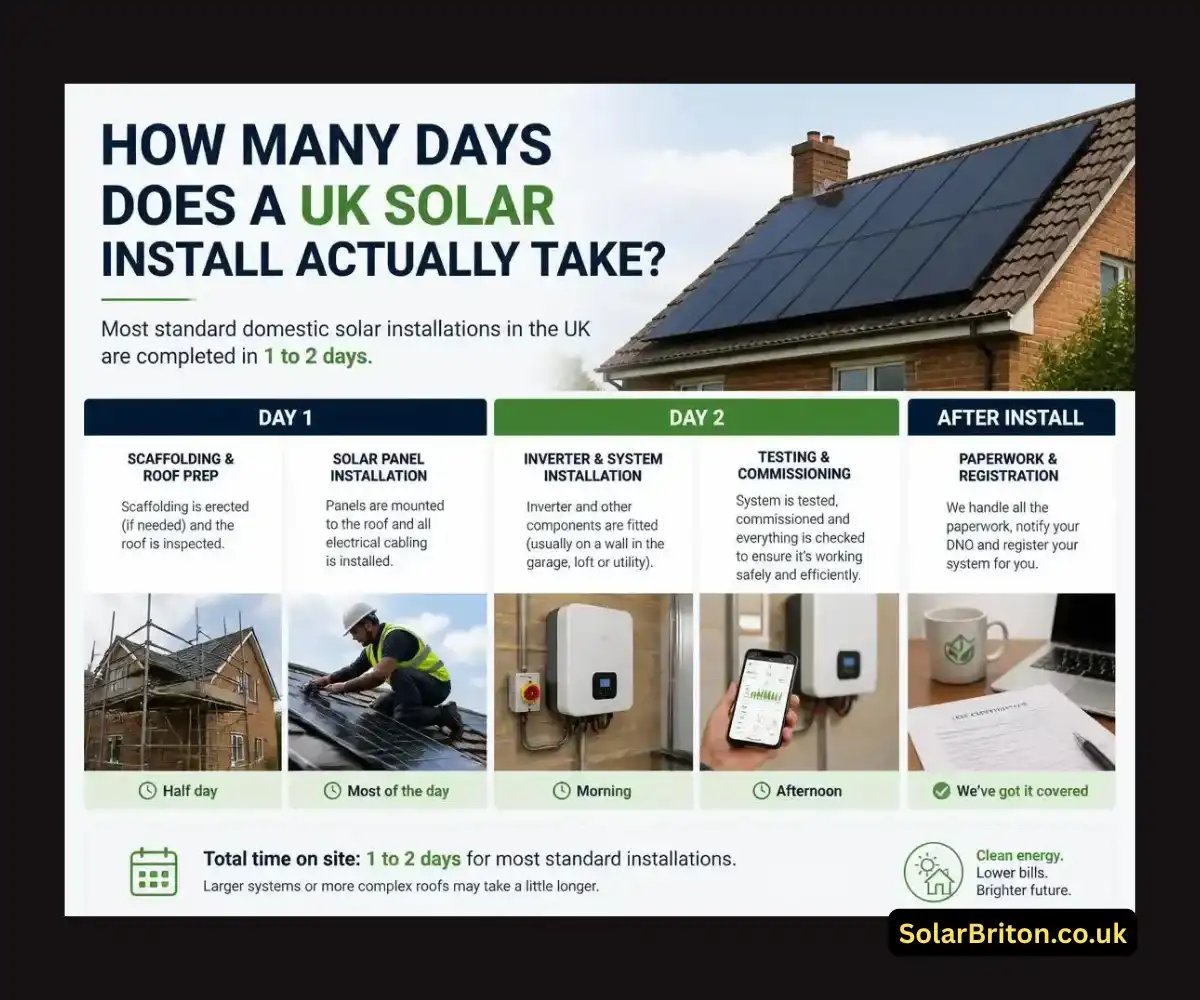
How Many Days Does a UK Solar Install Actually Take?

The honest answer most installers won’t put at the top of their page: 1–2 days on the roof, 4–8 weeks from first phone call to a live, exporting system. Here’s the full 2026 timeline, day by day — scaffolding, DNO waits, MCS paperwork, bifacial panel picks and all.
We get this question more than almost any other from UK homeowners weighing up solar. People have read that a system “only takes a day to fit” — then they’re surprised when six weeks have passed and there are no panels on the roof yet. So let’s clear it up properly, with the real numbers for 2026, the bit the sales pages skip over, and a no-nonsense breakdown of every stage from first enquiry to switch-on.
If you want the deeper context on system sizing, costs and grants before reading on, our main UK solar panels guide for 2026 covers all of that. This page is purely about time — how long each bit takes, what holds things up, and how to keep your project moving.
The full timeline, from first call to first export payment
The Energy Saving Trust — the body UK homeowners trust for impartial energy advice — confirms that once scaffolding is up, the actual panel fitting takes one to two days for a standard home. The longer 4–8 week window is everything that wraps around that single productive day or two. And it’s worth remembering how busy that window has become: official government data shows the UK passed 2 million solar installations in March 2026, with 27,000 fitted that month alone — the highest monthly figure in over a decade. Good installers are genuinely busy, which is why booking early matters.
You send over recent electricity bills and your postcode. A good installer checks roof orientation, pitch and shading on satellite imagery, then comes back with an indicative quote and system size. No scaffolding, no commitment — this part is fast if you respond promptly to emails. If you want to bypass the wait and get an instant personalised estimate for your roof, you can run your details through our free Solar Panel Calculator right now.
An installer visits to check the rafters, the consumer unit, the loft space for cable runs and where the inverter will live. They finalise the design and you sign off the quote. For most homes this stage takes 2–4 weeks, mostly depending on installer availability, not yours.
This is the single biggest variable. If your inverter is rated 3.68kW per phase or less, your installer uses the G98 route — fit first, notify the DNO within 28 days, no waiting. Bigger systems need a G99 application, and the DNO has up to 45 working days to approve it.
Scaffolding is a legal safety requirement under UK working-at-height rules — any installer offering to skip it to “save money” is a red flag. It usually goes up a day or two before the main crew arrive.
The bit you’ve been waiting for. Rails fixed, panels clipped on, inverter wired in, system tested and switched on. Expect a 20–60 minute power cut mid-afternoon while the team connects to your consumer unit.
Your installer must issue your MCS certificate within 10 days of commissioning. You then use it to apply for a Smart Export Guarantee (SEG) tariff — approval typically takes 1–4 weeks. To see what you’d actually earn before you apply, our free SEG Income Estimator runs the numbers for your system size and self-consumption.
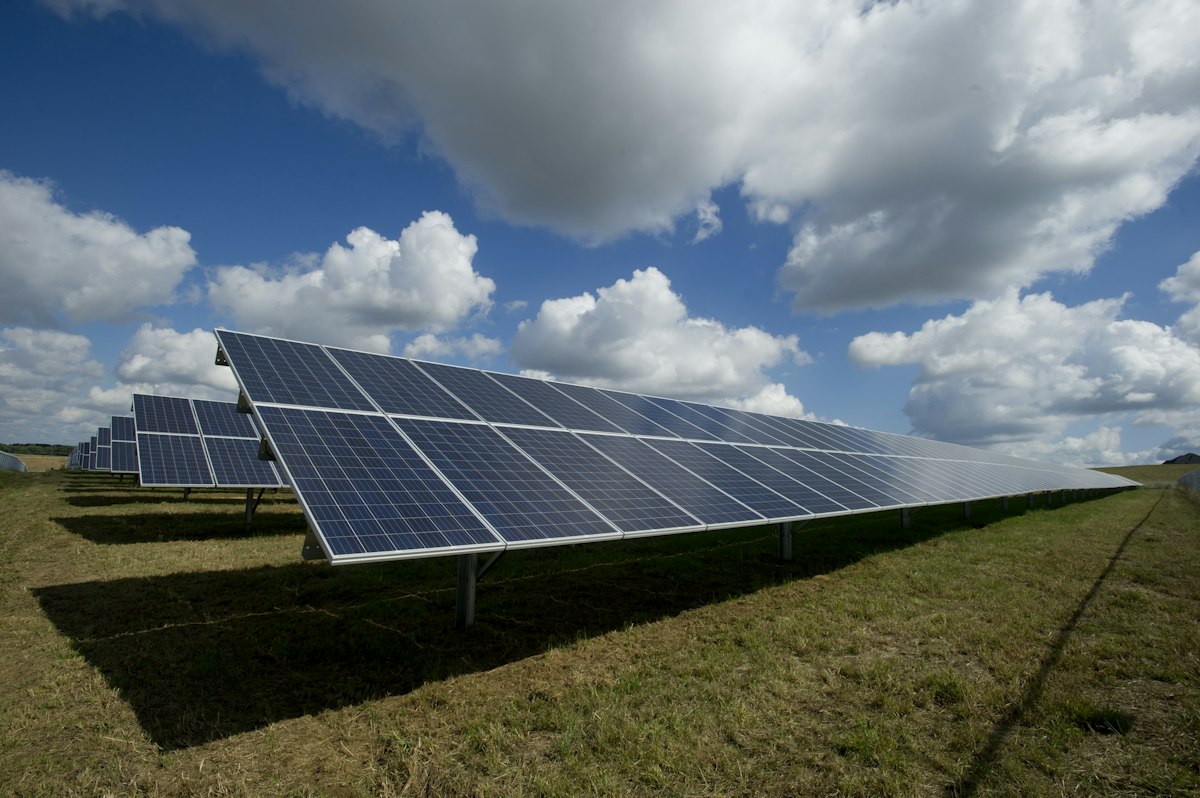
Most of the visible work happens in a single day; most of the calendar time happens before and after it.
What actually happens on installation day — hour by hour
For a standard 4kWp system on a typical British pitched roof with concrete tiles, here’s roughly how the working day unfolds. This mirrors the day described by the Energy Saving Trust’s own step-by-step installation guide and matches what we see on real UK jobs.
The crew (usually 2–3 MCS-certified fitters) arrive, confirm the scaffold is sound and do a walk-round with you to check panel layout and cable routes against the design you signed off.
Brackets are fixed into the rafters and flashed to keep the roof watertight. Aluminium rails are bolted on top. On a simple roof this takes 2–3 hours.
Panels are lifted up and clipped to the rails. DC wiring between panels is run to a junction point. A 10-panel array is often mounted in under two hours by an experienced team.
After lunch the electrician mounts the inverter (usually in a garage, loft or utility room) and, if you’re having one, the battery. DC cables are run down from the roof.
The AC side is wired into your consumer unit. Expect a 20–60 minute power cut while the isolator is fitted. This is the one moment you’ll notice the work indoors.
Every panel is DC-tested, the monitoring app is set up on your phone, and the installer walks you through the inverter display and what to do if an error appears. Scaffolding comes down the next working day.
If you’re adding battery storage at the same time, expect this to stretch into a second day. The battery unit has to be wall-mounted, wired between the inverter and consumer unit, and configured to talk to your smart tariff — that configuration alone is worth the extra hours, because it’s what unlocks the bigger savings. If you already have panels and are just adding storage, read our guide on adding a battery to existing solar panels to see how that timeline differs.
Should you ask for bifacial solar panels (and which brand is best)?
During your survey, your installer might ask if you want to upgrade to bifacial solar panels. Instead of a solid white backsheet, these have glass on both sides, allowing the rear of the panel to capture reflected sunlight (albedo) bouncing off your roof or the ground below. In the right conditions, they can generate 5–30% more electricity than standard monofacial panels.
But do they work on a standard UK pitched roof? Yes, but with a caveat. The gap between the panel and the roof tiles is usually quite small, meaning only a fraction of light reaches the rear. You’ll see a slight gain (maybe 5–7%), but nothing like the 30% boost you get on a ground-mounted array. They make the most sense if you have a ground-mounted system, a flat roof with a tilted mounting frame, or a very light-coloured roof surface. If you’re still getting to grips with the different panel types, our beginners’ guide explains the jargon in plain English, and for the deeper technology comparison between N-type TOPCon and older P-type PERC cells, our TOPCon vs PERC guide is worth a read.
If you decide bifacial is worth it, here are the main manufacturers offering bifacial residential panels in the UK market for 2026, and which one comes out on top:
Efficiency: Up to 24.8%
Warranty: 15 yr product / 30 yr power
Price: £80–£100 per panel
Best for: Premium UK residential roofs. Outstanding low-light performance and sleek aesthetics.
Efficiency: 22.3–22.6%
Warranty: 25 yr product / 30 yr power
Price: £75–£95 per panel
Best for: Long warranties and solid all-round performance.
Efficiency: 22.3–24.5%
Warranty: 30 yr power
Price: £75–£100 per panel
Best for: Budget-conscious buyers wanting Tier 1 bankability.
Efficiency: 22.0–22.4%
Warranty: 25 yr power
Price: £70–£90 per panel
Best for: Value for money with proven technology.
Efficiency: 22.6–23.5%
Warranty: 25 yr product
Price: £120–£160 per panel
Best for: Shaded roofs — unique quadrant shade tolerance.
Our verdict: The LONGi Hi-MO X10 is currently the best bifacial panel for a UK home. Its HPBC cell technology handles the UK’s diffuse, cloud-scattered light brilliantly, and the dual-glass construction looks fantastic on a residential roof. However, if you want a deeper comparison of how Jinko, Trina, and JA Solar stack up against each other on paper, check out our dedicated Jinko vs JA Solar vs Trina Solar guide. You can also see how bifacial models compare to monofacial and other types in our full best solar panels for UK homes in 2026 rundown.
The grid bit that catches everyone out: G98 vs G99
Before a single panel goes up, your installer has to deal with your local Distribution Network Operator (DNO) — the company that owns the physical power lines in your area. Which route they take depends on the size of your inverter, and it’s the part of the timeline most likely to surprise you.
| Route | When it applies | Process | Typical wait |
|---|---|---|---|
| G98 (notification) | Inverter ≤ 3.68kW per phase (16A) | Install first, notify DNO within 28 days of commissioning | No wait — fit and switch on |
| G99 (prior approval) | Inverter > 3.68kW per phase — common with battery + EV charger | Apply before install; DNO must approve before commissioning | Up to 45 working days, longer if grid needs reinforcement |
Sources: Ofgem SEG guidance, Energy Saving Trust, and the engineering recommendation G98/G99 framework.
Because more UK households are now pairing solar with a battery and an EV charger, larger inverter ratings are increasingly common — and that pushes more installs into the G99 queue. If your installer mentions G99, build a bit of buffer into your expectations. Eight weeks for the whole project is realistic; twelve isn’t unusual in congested grid areas.
What can slow your solar install down (and how to avoid it)
Even the best-organised project can hit a snag. Here are the things we see delaying UK installs most often, and what you can do about each one.
British weather
Installers can’t safely handle large, flat panels on a wet, slippery roof in high winds. Heavy rain, ice or gales mean a rescheduled day. Light drizzle usually just slows things down.
Complex roofs
Multiple sections, dormers, a pitch steeper than 40° or a slate roof all add time. Slate needs far more care than concrete tile and can add 2–4 hours to the day.
Listed building / conservation area
Most homes fall under Permitted Development and need no planning permission. Listed buildings and conservation areas do — and that adds a minimum of 8–12 weeks.
Battery & EV charger add-ons
Adding storage or a charger usually turns a one-day job into two, and may push you into G99 territory. Worth it for the savings, but plan for the extra time.
Grid reinforcement
If your local network is already loaded with solar, the DNO may require physical upgrades before approving your G99. This can add weeks or months and is outside your installer’s control.
Installer lead times
Good installers book up. Spring and summer are peak season. Booking your survey in late autumn or winter often means a faster slot and a system generating in time for the longer days.
How install time changes with system size
System size affects how long the crew is on your roof — though not by as much as you’d think. The big differences come from the add-ons (battery, EV charger) and the grid route (G98 vs G99).
| System | Approx. panels | Roof time | With battery | End-to-end |
|---|---|---|---|---|
| 2.5–3 kWp | 6–8 | 1 day | 1–2 days | 4–6 weeks |
| 4 kWp (most common) | 8–10 | 1–2 days | 2 days | 4–8 weeks |
| 5–6 kWp | 12–14 | 2 days | 2–3 days | 6–10 weeks* |
| Ground-mounted | varies | 2–3 days | +1 day | 6–12 weeks |
*Larger systems usually trigger G99, which adds grid-approval time. See our ground-mounted solar panels cost guide for that route.
What it costs — and the VAT quirk that ends in March 2027
Time isn’t the only thing worth planning around. A standard home solar system in the UK currently costs between £5,000 and £11,000 fully installed, with most 3–4 bedroom homes landing around £6,500–£8,000 for a 4kWp setup. And here’s the part that genuinely affects when you should book: 0% VAT on residential solar, battery storage and solar thermal runs until 31 March 2027. After that, the standard 20% rate is due to return.
That deadline is a quiet reason to get your survey booked sooner rather than later — if your install slips into April 2027, you could be paying the best part of £1,000–£2,000 more in VAT on a typical system. Not sure if you qualify for grants or VAT relief? Use our free UK Solar Grant & VAT Savings Checker to find out instantly. If the upfront cost is the real barrier rather than the timeline, our solar panel finance guide walks through the loans and green mortgage options available in 2026. For a deeper look at the break-even point once the panels are generating, our solar panel payback period guide does the maths in full.
How to keep your install on the fastest possible track
Plenty of the timeline is out of your hands — the DNO, the weather, the grid. But there’s a surprising amount you can control to stop the weeks from dragging.
- Have your bills ready. The remote assessment needs your annual kWh usage. Emailing a year’s worth of statements on day one shaves days off the survey stage.
- Clear the loft and consumer unit. The electrician needs physical access to both. A cluttered loft is one of the most common reasons a survey overruns.
- Confirm the inverter size early. If you can stay at 3.68kW or below, you stay on G98 and skip the 45-day DNO wait entirely.
- Book in the off-season. Surveys and install slots are easier to come by in late autumn and winter, and your system will be ready for the longer spring days.
- Use an MCS-certified installer. Only MCS-certified installs qualify for SEG payments, and the certificate has to be issued within 10 days of commissioning. Non-certified fitters can leave you generating but unable to get paid for exports.

Your questions, answered
How many days does a solar panel installation take in the UK?
The physical installation of a standard 4kWp UK solar system takes 1–2 days on the roof. Add a battery and it usually becomes a full two-day job. From your first enquiry to a fully live, exporting system, most UK homeowners are up and running within 4–8 weeks in 2026.
How long does DNO approval take for solar panels in the UK?
For systems of 3.68kW per phase or less, your installer uses the G98 notification process and can commission immediately, notifying the DNO within 28 days. For larger systems, a G99 application is required and the DNO has up to 45 working days to approve it, sometimes longer if the local grid needs reinforcement.
Do I need to be at home during the solar installation?
Yes, a responsible adult should be at home. The team needs access to your loft, the inverter location and your consumer unit (fuse board). There’s a brief power cut of around 20–60 minutes while the system is connected, and you’ll need to be there for the final handover and paperwork.
More questions? Our main solar panels FAQ covers costs, grants, sizing and everything else UK homeowners ask us. To compare the best export rates for your setup once you’re live, check our SEG Rate Comparison page.




One Comment