
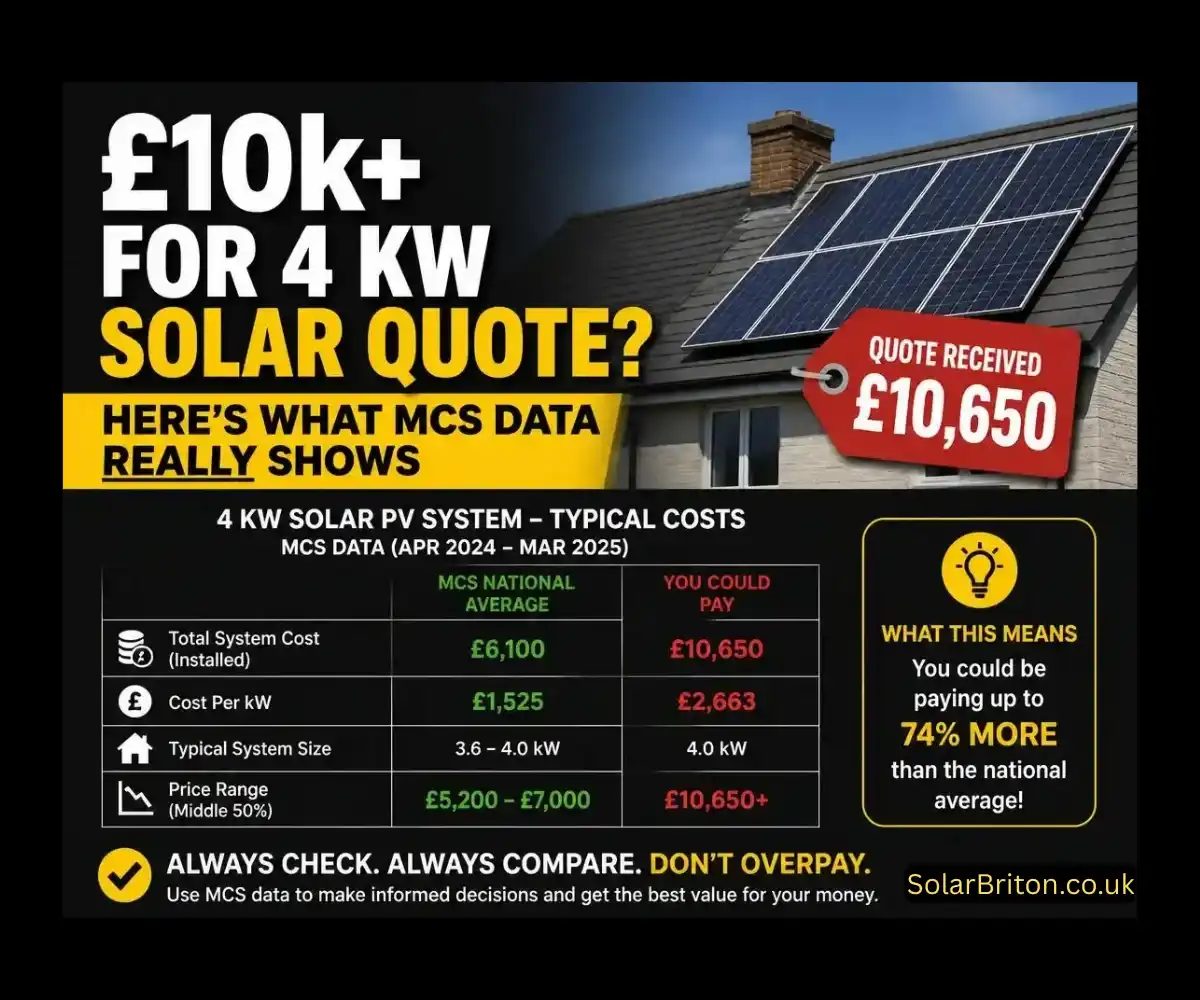
£10k+ for 4 KW Solar Quote? Here’s What MCS Data Really Shows

Quoted £10k+ for 4kW Solar? Here’s the Real MCS Data
You’ve had three quotes back for what’s supposed to be the same system, and none of them agree. One installer says £6,800. Another wants £11,500. A third has quietly added a battery and called the total £14,000. So what should a standard 4kW system actually cost right now? We went and found the real 2026 installation data.
Why are some quotes still £10,000+?
If you’ve started collecting quotes for a 4kW solar system this year, you’ve probably noticed the numbers don’t line up. Search around and you’ll find one site quoting £5,500, another £9,000, and a salesman on the doorstep offering “today only” pricing at £14,000 — for what’s meant to be the same 10-panel setup. That’s not you being bad at comparing quotes. The market genuinely is that scattered, and the gap between a fair price and an inflated one on an otherwise ordinary system can run into thousands of pounds.
Rather than asking installers what they’d like to charge, we went to the actual installation data instead — the numbers that come from real MCS-certified jobs going onto UK roofs, not a marketing page. Here’s what it shows, and how to tell whether your own quote is one of the fair ones or one of the padded ones. If you haven’t started the process yet, our guide to finding an MCS-certified installer is worth reading alongside this.
What a 4kW system should cost in 2026
A “standard 4kW system” means 8 to 12 panels (usually 400–450W each), a matching inverter, mounting hardware, and full installation — no battery. It’s the size that fits most UK three-bedroom semis, which is exactly why it gets the widest, most inconsistent quotes.
Pulling together 2026 MCS-linked installation data and independent industry cost analysis, the picture is fairly consistent: a properly specified 4kW system, fully installed with 0% VAT, should land somewhere between £6,000 and £8,500 — averaging out around £7,000–£7,500 for a straightforward roof. That works out to roughly £1,500–£1,700 per installed kW, which is honestly the more useful number once you start comparing systems of different sizes. Add a 5–10kWh battery and the fair range shifts to about £9,500–£12,500. We’ve broken every system size down in more detail on our solar panel cost hub if you want the fuller picture.
| System size | Panels (approx) | Fair installed price* | £ per kWp | Typical payback |
|---|---|---|---|---|
| 3 kWp | 6–8 | £4,500–£6,000 | ~£1,600 | 8–11 yrs |
| 4 kWp | 8–12 | £6,000–£8,500 | ~£1,600 | 7–11 yrs |
| 5 kWp | 12–14 | £7,500–£9,500 | ~£1,650 | 7–10 yrs |
| 6 kWp | 13–16 | £9,000–£11,500 | ~£1,650 | 8–11 yrs |
| 4 kWp + battery | 8–12 + 1 battery | £9,500–£12,500 | — | 8–12 yrs |
*Fully installed, includes 0% VAT. Figures are averages — your exact price depends on roof type, panel brand and location.
Where do £10k+ quotes actually sit?
4kW system, no battery. Green marks the fair 2026 range — anything landing well past it deserves a question.
The number that actually matters is £ per kWp, not the headline total. A 4kWp system quoted at £7,000 and a 5kWp system quoted at £8,750 are priced identically per kW. Whenever you’re comparing two quotes, divide the total by the system size in kWp before you decide which one looks better.
So why is one quote £6,800 and another £11,500?
Some of that spread is completely legitimate. A chunk of it isn’t.
What a fair quote is made up of
Rough breakdown for a straightforward 4kW installation
Roughly a third of the bill is the panels and inverter themselves. Labour and scaffolding is the single biggest swing factor — a simple single-storey south-facing roof costs a fraction of a steep, multi-angled slate roof needing scaffolding on three sides. Stack on premium components like microinverters, black-on-black panels or a bigger battery, and an extra £1,500–£2,500 on the base price is genuinely normal.
What isn’t normal: a national sales-led firm baking heavy advertising spend into every quote, “sign today or the price goes up” pressure, or a quote that simply says “high quality panels” with no brand or model attached. None of that reflects what the job costs to actually do — it reflects what they think they can get you to sign for.
Is your quote fair? Find out in seconds
Already got a number back from an installer? Pop it in below and we’ll show you where it sits against the real 2026 range for a straightforward 4kW system.
🔎 The Fair Price Meter
Enter the total you were quoted for your 4kW system. This is a quick sense-check, not a substitute for getting three proper written quotes.
Does it matter where in the UK you live?
A bit, yes — though less than most people assume. Installers in the South East and South West typically charge somewhere around 10–15% more than the UK average, largely down to higher local labour costs and busier installer books. Homes in those regions also generate meaningfully more electricity, which softens the difference when you look at payback rather than upfront price. Head further north and it’s roughly the reverse: lower installation costs, offset by somewhat lower generation. Either way, the fair range holds — it just shifts a little in each direction.
Installed cost vs UK average, by region
Approximate variation from the national average — not absolute prices
The 0% VAT window is part of this story too
Every fair-price figure above already includes the current 0% VAT rate on residential solar installations in Great Britain — confirmed by HMRC’s guidance on energy-saving materials to run until 31 March 2027, before reverting to the reduced 5% rate. On a typical £7,500 system, that’s worth roughly £375 the moment the relief ends. Not life-changing, but real — and one more reason not to let a confusing set of quotes stall you into missing the deadline. Our VAT and grant savings checker can tell you exactly what applies to your situation.
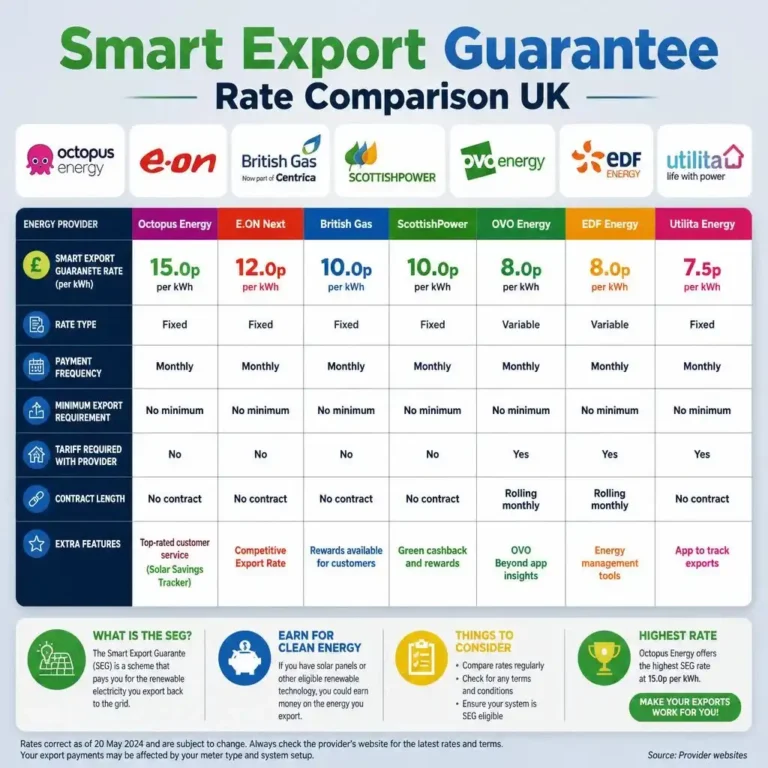
It’s also worth checking your installer’s MCS status before you sign anything. Smart Export Guarantee payments, most grant schemes, and increasingly your home insurance all depend on it — and UK solar deployment has genuinely accelerated this year, with government data confirming the UK passed 2 million solar installations and 22.3 GW of capacity in the year to April 2026, on the way to a stated ambition of up to 70 GW by 2035. You can check any installer’s live status on the official MCS installer register in about two minutes. Once you’re set up, our SEG income estimator will show what you could realistically earn back from exporting.
Five things to check before you sign anything
Takes ten minutes, saves you from the quotes that don’t hold up.
Named components
Brand and model number for both panels and inverter — not just “high quality panels.” If they won’t name it, ask why.
A real site survey
No fixed-price quote is genuine without someone physically looking at your roof, shading and electrical setup first.
£ per kWp, not just the total
Divide the price by the system size in kWp. It’s the only way to fairly compare two differently sized quotes.
Live MCS certification
Check it’s active and covers Solar PV specifically — not just a logo sitting on their homepage.
Three separate quotes
From three independently-owned MCS installers — not three quotes funnelled through the same national reseller.
If you want the fuller version of this — red flags, deposit rules, and what a proper written quote should include — our complete guide to finding an installer covers it step by step. And if your quote includes a battery, it’s worth checking that side of the number separately too — see what a home battery can realistically add to your savings. If you’re still weighing up whether it’s worth doing at all, it’s also worth knowing what solar typically adds to a home’s resale value.
Frequently asked questions
How much should a 4kW solar system actually cost in the UK in 2026?
Why do solar panel quotes vary so much between installers?
Is £10,000 too much to pay for a standard 4kW solar system?
The short version: a fair 2026 quote for a standard 4kW system sits somewhere between £6,000 and £8,500, with battery systems running £9,500–£12,500. Anything meaningfully above that deserves a straight answer about what’s driving the cost. If you don’t get one, that’s reason enough to walk away and get a third quote instead.


3 Comments